In modern bridge and highway construction, project managers frequently face severe physical space limitations on site. As infrastructure projects increasingly move into dense urban centers, mountainous regions, or adjacent to existing active transport lines, the available working area—often referred to as the construction right-of-way—is highly restricted.
Under these tight spatial constraints, traditional lifting equipment presents significant operational challenges:
- All-Terrain and Crawler Cranes: These units require large outrigger spans or wide tracks to maintain stability. When lifting heavy precast concrete segments, their swing radius requires a clear overhead and horizontal envelope, which is often unavailable due to nearby buildings, utility lines, or active traffic lanes.
- Rail-Mounted Gantry Cranes (RMGs): These systems depend on fixed steel rails. Laying straight, stable rails is often physically impossible on curved highway segments, uneven mountain terrain, or in areas with non-rectilinear site boundaries. Additionally, the civil works required to construct rail foundations are costly and time-consuming.
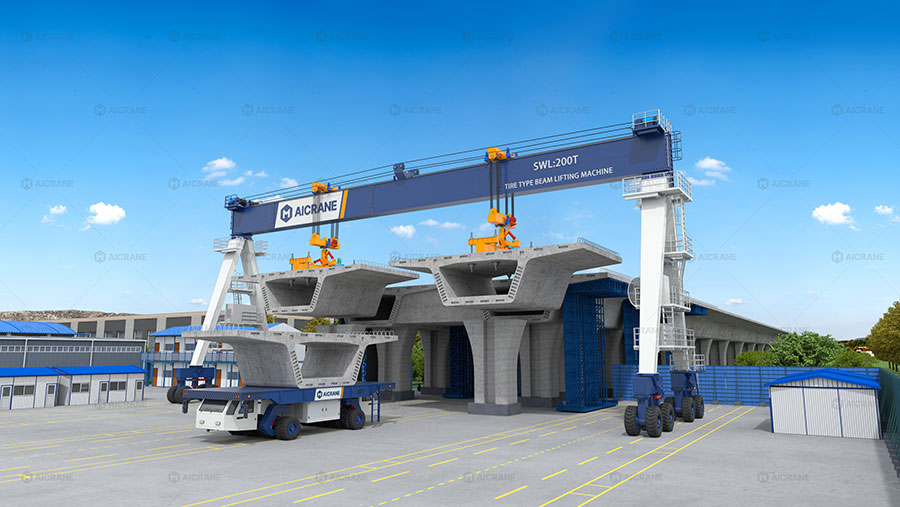
To address these limitations, many contractors now deploy Rubber Tyred Gantry Cranes (RTGs). This article examines how the mobility, steering capabilities, and structural design of RTG cranes help contractors manage space-constrained environments effectively.
1. Key Spatial Challenges in Road and Bridge Construction
Lifting, moving, and positioning heavy precast concrete beams in confined spaces requires overcoming three main physical bottlenecks:
Outrigger Footprint and Blocking of Traffic
When lifting heavy precast girders, conventional mobile cranes must fully extend their hydraulic outriggers and place large steel mats to distribute the load and prevent tipping. On narrow urban roads or two-lane highways, this outrigger footprint often blocks the entire roadway. This halts local traffic and prevents delivery trucks or auxiliary machinery from accessing the immediate work zone.
Strict Geometrical Requirements for Rail Installation
While RMGs offer high lifting capacities and stable operation, they require straight, level tracks. On projects characterized by sharp curves, steep longitudinal slopes, or irregular ground elevations, constructing a flat and rigid concrete foundation for rails is not feasible due to physical space limits.
Frequent Remobilization and Downtime
Bridge and highway construction is a linear process. As the bridge spans are erected sequentially, the lifting equipment must move forward along the project alignment. Dismantling, transporting, and reassembling a conventional gantry crane at each new span takes several days, leading to substantial downtime and high labor costs.
2. Technical Features of RTG Cranes That Address Space Limits
RTG cranes are designed to operate in narrow spaces by combining the high capacity of a gantry structure with the mobility of rubber-tyred vehicles.
Trackless Mobility and Lower Ground Preparation Costs
Unlike rail-bound equipment, RTGs run on heavy-duty rubber tires. They can operate directly on compacted gravel, asphalt, or concrete roadways without the need for fixed rails.
- Minimal Lateral Clearance: Because they do not require rails or the safety clearance buffers associated with rail installations, the span of an RTG can be customized to match the exact width of the construction zone. The outer frame of the crane can operate close to the boundary of the site.
- Elimination of Rail Infrastructure: By removing the need for concrete rail foundations, RTGs reduce the time and cost associated with preliminary civil works, allowing the crane to go into service immediately upon arrival and assembly.
Multi-Directional Steering Modes
Navigating a large crane through narrow access roads is difficult. Modern RTGs utilize hydraulic or electro-hydraulic steering systems that support several highly precise steering configurations:
-
- Straight and Crab Steering: The wheels can turn 90 degrees, allowing the mobile gantry crane to travel sideways (laterally) as well as forward and backward. In narrow precast storage yards, this allows the RTG to move sideways directly into a storage slot, eliminating the need for wide turning areas.
- Pivot Steering (360-Degree Rotation): The RTG can rotate 360 degrees around its own geometric center. This allows the operator to change the direction of the crane within a footprint equal to its own diagonal dimension, which is useful in dead ends or single-lane roads.
- Ackermann Steering: This mode allows the crane to travel along curved highway segments or ramps smoothly, following the natural alignment of the road.
Gantry Structure with Zero Tail Swing
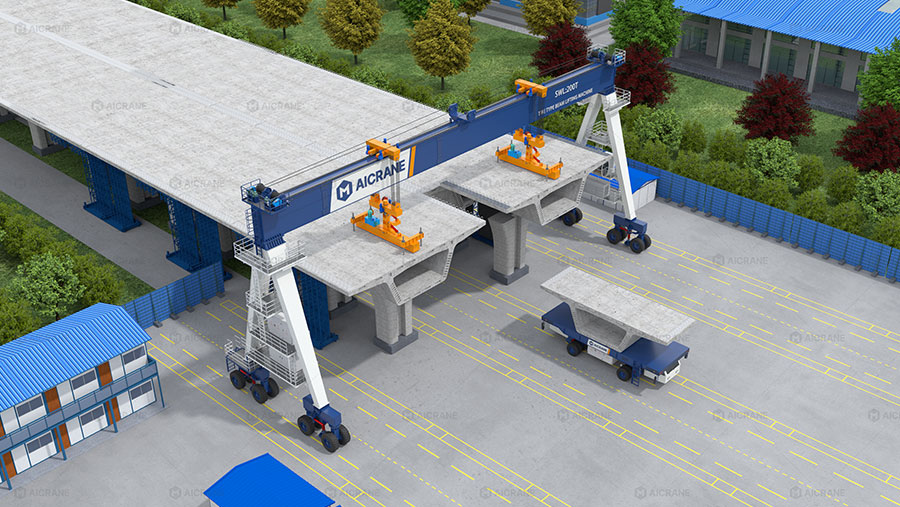
Unlike boom cranes that rotate a counterweight and crane arm, an RTG uses a portal frame structure.
- No Swing Radius Hazards: The lifted precast girder remains within the span of the gantry. Because the crane does not rotate its main body to position loads, there is no tail swing radius to monitor. This eliminates the risk of striking adjacent buildings, power lines, or trees during lifting operations.
- Vertical Space Utilization: In narrow precast yards, RTGs can stack concrete girders two or three levels high within their own span, multiplying the storage capacity of a restricted footprint.
3. Practical Application Scenarios
Scenario A: Urban Viaduct Construction Parallel to Active Traffic
When expanding an urban highway or building a light rail line in a city center, the work often takes place directly above or adjacent to active roadways.
- RTG Application: Contractors can configure an RTG with a span that covers only one or two closed lanes. The RTG travels linearly within the closed zone, lifts precast segments from delivery trucks positioned behind it, and carries them longitudinally to the erection point. This allows adjacent lanes to remain open, reducing traffic disruption.
Scenario B: Mountain Bridge Construction Near Tunnel Portals
Mountain highways often feature bridges connected directly to tunnel portals, leaving very little flat terrain at either end of the span for assembling and operating heavy cranes.
- RTG Application: Due to their modular design, RTGs can be transported in sections via standard flatbed trucks and assembled on the small flat areas near tunnel entrances. Once assembled, the RTG uses the climbing ability of its rubber tires to navigate temporary slopes and move onto the bridge substructure to place the initial spans.
Scenario C: Highway Widening Projects (Lane Additions)
Widening projects require constructing new bridge structures directly adjacent to an existing, active bridge.
- RTG Application: An RTG can straddle the boundary between the old and new structures. One side of the straddle crane travels on the closed outer lane of the existing bridge, while the other side travels on a temporary access road or embankment. This configuration allows the safe installation of new girders without placing heavy, rotating mobile cranes on the active bridge deck.
4. Economic and Operational Benefits
For highway and bridge contractors, implementing RTGs offers clear financial and operational advantages:
- Reduced Project Timelines: Because RTGs can be driven or towed on trailers between work areas without complete disassembly, mobilization times are significantly shorter than those for traditional RMGs.
- Lower Civil Preparation Costs: Contractors do not need to invest in heavy concrete foundations for rails. The RTG runs on standard compacted soils or existing road surfaces, lowering temporary works budgets.
- Enhanced Safety in Restricted Areas: The vertical load distribution of a gantry crane provides a lower center of gravity and higher structural stability than a single-boom crane. Equipped with active anti-sway systems and laser obstacle detection, RTGs minimize the risk of collisions in tight spaces with active traffic or structures.
Conclusion
Managing space constraints effectively is a critical factor in maintaining project schedules and budgets in modern infrastructure construction. Rubber Tyred Gantry (RTG) cranes provide a practical alternative to traditional lifting methods by combining trackless mobility, precise multi-directional steering, and a stable gantry design. For projects involving narrow urban corridors, mountainous terrain, or highway expansion, RTGs help contractors maximize productivity within tight physical boundaries.