Yes, a 20 ton gantry crane can lift precast concrete panels, but the rated 20 ton capacity alone does not determine whether the crane is suitable for a particular panel. The actual panel weight, lifting arrangement, working radius, lifting height, panel dimensions, wind conditions, and required operating frequency all need to be considered.
For precast concrete yards and construction projects, a 20 ton gantry crane is often used to move wall panels, floor elements, beams, molds, and other precast components between casting, curing, storage, and loading areas. However, a panel that weighs 18 tons is not automatically a safe load for a crane rated at 20 tons.
The key question is not simply “Can the crane lift 20 tons?” It is “Can the complete lifting system safely handle this particular precast panel under the actual site conditions?”
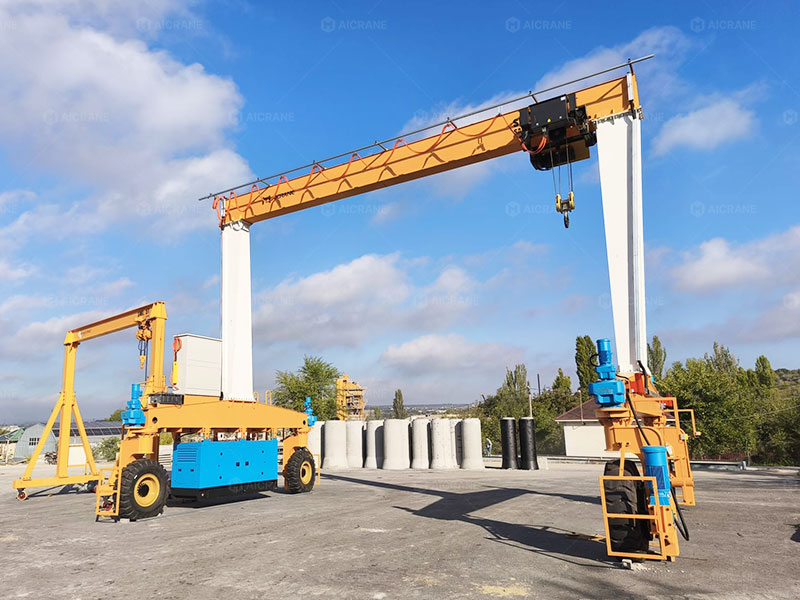
What Determines Whether a 20 Ton Gantry Crane Can Lift a Precast Panel?
Several factors should be checked before selecting a 20 ton gantry crane for precast concrete handling.
1. Panel Weight
The first and most obvious factor is the actual weight of the precast panel.
A concrete panel weighing 10–12 tons leaves substantially more capacity margin than one weighing 19–20 tons. The panel weight should be calculated from its dimensions and material density when the final weight is not yet available.
For example, a solid reinforced concrete panel measuring:
- Length: 8 m
- Height: 3 m
- Thickness: 0.25 m
has a volume of:
8 × 3 × 0.25 = 6 m³
Using an approximate reinforced concrete density of 2.4–2.5 tons/m³, the panel could weigh around 14.4–15 tons before considering any embedded components or lifting accessories.
A larger panel measuring 10 m × 3 m × 0.3 m would have a volume of 9 m³ and could weigh approximately 21.6–22.5 tons. In that case, a 20 ton gantry crane would already be undersized.
This simple calculation can eliminate unsuitable crane capacities before detailed engineering begins.
Why a 20 Ton Crane Should Not Normally Operate at Its Maximum Rated Capacity
A crane rated for 20 tons has a 20 ton safe working load rating under its specified design and operating conditions. It does not mean that every 20 ton load is an ideal operating load.
For precast handling, it is often better to select the crane so that normal loads remain below the maximum rated capacity.
For example, if the heaviest panel is 16 tons, a 20 ton crane provides a 4 ton difference between the panel weight and rated capacity. That difference is useful because the lifting system also includes equipment such as:
- Spreader beams
- Slings
- Shackles
- Lifting clamps
- Hooks
- Other lifting accessories
If these components have a combined weight of 0.5 ton, a 16 ton panel creates a total suspended load of approximately 16.5 tons.
This is why the gross lifted load, rather than only the concrete panel’s own weight, should be used when checking gantry crane capacity.
For panels approaching 20 tons, a higher-capacity crane may be more appropriate, particularly when the project involves frequent lifting, tilting, turning, or handling under demanding site conditions.
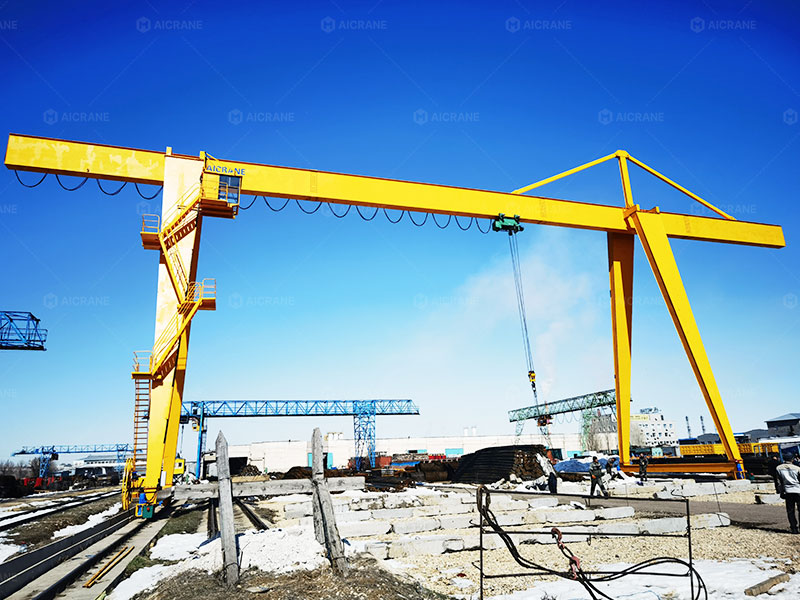
Lifting Points Are Critical for Precast Concrete Panels
Panel weight is only one part of the calculation. The lifting points and load distribution are equally important.
Precast concrete panels may be designed with embedded lifting anchors or other lifting devices. These points determine how the load is transferred from the panel to the lifting equipment.
Consider a rectangular wall panel lifted from four points. Ideally, the lifting arrangement should distribute the load appropriately between the lifting points. However, unequal sling angles, differences in lifting point elevation, panel flexibility, and variations in anchor position can result in uneven loading.
For example, a 16 ton panel theoretically supported equally by four lifting points would have 4 tons at each point. In practice, the load may not divide perfectly into four equal portions.
The crane designer therefore needs information about:
- Number of lifting points
- Location of lifting anchors
- Distance between lifting points
- Panel center of gravity
- Sling configuration
- Required lifting angle
- Whether the panel is lifted horizontally or vertically
A spreader beam can be useful when lifting large wall panels because it helps control sling angles and reduces the tendency of the slings to pull inward on the panel.
Panel Dimensions Can Be as Important as Panel Weight
A relatively light precast panel can still create a difficult lifting operation if it is very large.
For example, a 10 ton panel measuring 10 m long and 3.5 m high has a large surface area. When the panel is lifted vertically outdoors, wind can become a significant factor.
The crane may have sufficient capacity to lift the 10 ton panel, but the panel’s large surface area can make positioning and controlling the load more difficult.
This is particularly important when panels are moved:
- Between casting beds
- Into storage areas
- Onto transport vehicles
- Into construction zones
- Around existing structures
The crane should therefore be evaluated for both load capacity and physical handling requirements.
Lifting Height Must Match the Construction Process
A 20 ton gantry crane may have sufficient capacity but still be unsuitable if its lifting height is inadequate.
Suppose a precast yard needs to remove wall panels from casting molds and place them onto transport trailers. The crane may need enough hook height to clear:
- The casting bed
- The panel itself
- Storage supports
- Trailer decks
- Other equipment in the working area
The required lifting height should therefore not be based only on the height of the panel.
For example, a project may require a 5 m lifting height, but if the panel must be transferred over a 2 m-high trailer and positioned above other stored components, a greater hook height may be required.
The available headroom and crane overall height should also be checked against buildings, electrical equipment, roof structures, and other obstacles.
Span Should Match the Precast Yard Layout
The span of a 20 ton gantry crane determines how much of the working area can be covered.
A precast yard may have casting beds arranged in parallel rows, with storage areas and loading lanes located between them. If the crane span is too narrow, operators may need additional equipment to move panels outside the crane’s working area.
For example, if a yard requires the crane to cover an 18 m-wide production zone, selecting a crane with a 10 m span would leave a large portion of the area inaccessible.
At the same time, making the span unnecessarily large can increase the structural size and cost of the gantry crane.
The practical approach is to determine the required coverage from the actual site layout rather than choosing the span based on a standard catalog dimension.
Ground Conditions Matter for a Gantry Crane in a Precast Yard
Many precast operations use outdoor gantry cranes because the production and storage areas are large. A 20 ton gantry crane operating on rails or rubber tires transfers substantial loads to the ground.
For a rail-mounted gantry crane, the foundation and rail system must be designed for the crane wheel loads and operating conditions.
For a rubber tyre gantry crane, the ground must provide sufficient bearing capacity and a reasonably level travel surface.
This is especially important when handling heavy precast panels because the crane is not only carrying the suspended load. Its own structural weight also contributes to the total wheel or leg loading.
Before installation, the project should consider:
- Ground bearing capacity
- Rail foundation requirements
- Yard surface condition
- Drainage
- Settlement risk
- Crane travel path
- Levelness and alignment
A 20 ton crane installed on an unsuitable surface can create operational problems even if its lifting mechanism is correctly sized.
Outdoor Wind Conditions Should Not Be Ignored
Large precast wall panels behave differently from compact steel components when exposed to wind.
A panel measuring several meters in height can act almost like a sail when suspended. Wind can cause the panel to rotate, swing, or become difficult to position.
This is why the allowable wind speed for lifting operations should be established according to the crane design, panel dimensions, local regulations, and the project’s lifting procedure.
For outdoor precast yards, the crane may also require features such as:
- Rail clamps
- Anchoring devices
- Travel brakes
- Wind alarms
- Emergency stop systems
These systems serve different purposes, and they should not be treated as substitutes for proper operating procedures.
The crane operator should also follow a site-specific rule for stopping lifting operations when wind conditions exceed the permitted limit.
Single Girder or Double Girder for a 20 Ton Precast Application?
Both single girder and double girder gantry cranes can be designed for 20 ton lifting applications, but the better choice depends on the operating requirements.
A single girder gantry crane may be suitable when the lifting frequency is moderate, the lifting height is reasonable, and the overall crane dimensions do not demand a heavier structure.
A double girder gantry crane generally provides a more robust configuration for demanding applications. It can offer greater structural stability and is often considered when the crane needs higher lifting height, wider span, heavier-duty operation, or more frequent handling of large loads.
For a precast plant operating several shifts per day, where heavy panels are moved continuously between production and storage areas, the crane’s duty class and operating cycle should be considered carefully rather than choosing between single and double girder solely based on purchase price.
How Much Capacity Margin Is Reasonable?
There is no universal percentage that should automatically be added to every crane capacity. The correct capacity depends on the actual load spectrum and engineering requirements.
As a practical example, consider a project where:
- Maximum panel weight: 16 tons
- Lifting accessories: 0.5 ton
- Maximum suspended load: approximately 16.5 tons
- Required lifting height: 8 m
- Required span: 20 m
- Outdoor operation
- Frequent daily lifting
A 20 ton crane may be technically capable of handling the load, but the project should still be reviewed against the crane’s duty classification, lifting mechanism, structural design, wind conditions, and lifting accessories.
If the maximum panel weight increases to 19 tons, the situation changes considerably. After adding lifting accessories, the total suspended load could approach the crane’s rated capacity. In that case, moving to a higher-capacity crane may provide a more appropriate engineering solution.
The capacity decision should therefore be based on the heaviest actual lifting condition and the required operating cycle, not simply on the nominal weight of an average panel.
What Information Should You Provide When Ordering a 20 Ton Gantry Crane?
A crane manufacturer can make a much more accurate recommendation when the customer provides specific project information.
For a precast concrete application, the basic technical data should include:
- Maximum precast panel weight
- Typical panel weight
- Panel dimensions
- Number and position of lifting points
- Required lifting height
- Required crane span
- Crane travel distance
- Indoor or outdoor operation
- Working hours per day
- Lifting frequency
- Required lifting speed
- Ground or rail conditions
- Local power supply
- Local wind conditions
- Ambient temperature
- Any special positioning or turning requirements
If panels need to be rotated from horizontal to vertical, that should be stated at the design stage. A normal vertical lifting operation and a panel rotation operation can impose very different requirements on the lifting arrangement.
Final Answer: Can a 20 Ton Gantry Crane Lift Precast Concrete Panels?
Yes, a 20 ton gantry crane can lift many types of precast concrete panels, provided the total suspended load and operating conditions fall within the crane’s designed limits.
For example, a 12–16 ton precast panel can be a reasonable application for a 20 ton crane when the lifting accessories, lifting points, span, height, duty class, ground conditions, and environmental factors have all been properly considered.
However, a panel close to 20 tons should not automatically be assigned to a 20 ton crane. The weight of the lifting equipment must be included, and the complete lifting arrangement needs to be checked. Large panels also require additional attention to wind, stability, sling angles, and load distribution.
For a new precast yard or construction project, the best starting point is to define the heaviest panel, panel dimensions, lifting points, required span, lifting height, operating frequency, and site conditions. These parameters allow the gantry crane structure, hoist, lifting accessories, and supporting infrastructure to be matched to the actual job rather than relying on capacity alone.
A properly selected 20 ton gantry crane can provide an efficient solution for moving precast wall panels, beams, slabs, molds, and other heavy concrete components through casting, storage, loading, and construction operations. The important part is making sure the crane is designed around the real lifting process—not just the number “20 tons” on the nameplate.