Building strengthening projects in Kenya often involve concrete placement under conditions that are far less straightforward than those encountered in new-build construction. Existing columns, beams, floors, walls, utilities, scaffolding, and occupied spaces can restrict the movement of concrete delivery equipment. Strengthening work may also require concrete to reach elevated floors, narrow structural zones, or areas separated from the access road by existing buildings. These constraints directly influence the type of pumping equipment required, the length and configuration of the delivery pipeline, and ultimately the concrete pump price in Kenya.
The equipment cost is therefore only one part of the pricing equation. A compact strengthening project may use a mixer pump when access and output requirements are modest, while a larger structural rehabilitation project may require a stationary concrete pump or boom pump. Pumping distance, vertical reach, concrete volume, site maneuverability, repositioning frequency, and placement precision all contribute to the final cost. Understanding these variables makes it easier to distinguish between a genuinely suitable pumping solution and equipment that appears economical but performs poorly under actual site constraints.
Why Concrete Placement Constraints Affect Pumping Costs
Restricted Access Changes Equipment Requirements
Building strengthening frequently takes place around structures that are already standing. Access routes may be narrow, internal spaces may be congested, and conventional concrete trucks may not be able to approach the exact placement point.
In such situations, concrete must travel through pipelines, hoses, or boom systems. The greater the physical separation between the concrete source and the placement location, the more carefully the pumping configuration must be selected. Additional pipeline sections, bends, supports, and repositioning can increase both equipment requirements and operating time.
Vertical and Horizontal Pumping Increase Technical Demands
Concrete placement becomes more demanding when strengthening work extends upward or deep into an existing structure. A pump delivering concrete to an upper floor must overcome vertical elevation in addition to pipeline resistance. Long horizontal routes create another layer of pressure loss.
Consequently, a pump’s nominal output alone cannot determine its suitability. Pump pressure, concrete consistency, pipeline diameter, aggregate characteristics, and total conveying distance must be considered together. A machine with a high advertised capacity may not achieve that rate under a heavily restricted placement configuration.
How Site Conditions Influence Concrete Pump Price in Kenya
Pumping Distance and Elevation
Distance is one of the most obvious cost variables. A strengthening project where concrete is discharged only a few meters from the pump presents a fundamentally different pumping requirement from a high-rise building rehabilitation project.
Longer pipelines require additional components and more careful routing. Vertical pumping may also demand equipment with greater pressure capability. As the placement envelope expands, the technical specification of the pump becomes more important, which can increase the concrete pump price.
Pipeline Layout and Repositioning
Existing buildings can force pipelines to follow convoluted routes. Sharp bends, multiple vertical transitions, and restricted corridors can complicate concrete delivery. Each bend introduces additional resistance, while repeated repositioning can increase setup and labor requirements.
A relatively inexpensive pump may therefore become costly to operate if the site requires frequent relocation. Conversely, a better-matched pumping system may have a higher initial price but reduce installation time and interruptions during concrete placement.
Required Concrete Output
The quantity of concrete required for strengthening is another important consideration. Column jacketing, beam enlargement, slab strengthening, shear-wall construction, and structural repairs can have very different placement rates.
For small-volume repair work, excessive pumping capacity may provide little practical benefit. For a large strengthening program involving multiple structural elements, insufficient output can extend the working period and increase labor and equipment utilization costs.
Equipment Choices Behind Concrete Mixer Pump and Boom Pump Pricing
Concrete Mixer Pump for Smaller Strengthening Works
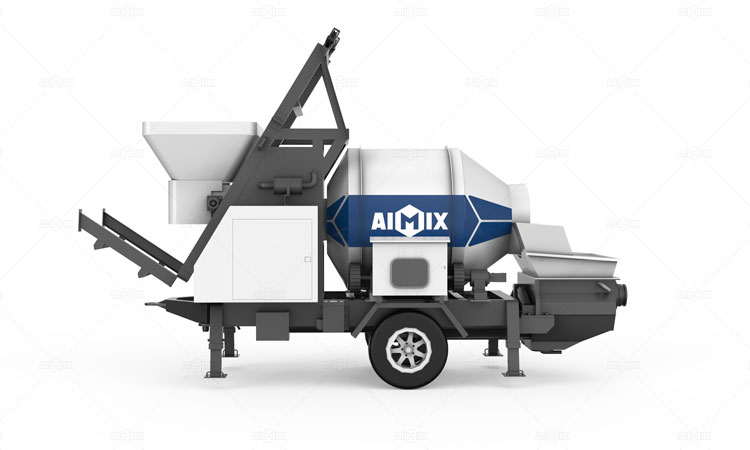
A concrete mixer pump combines concrete mixing and pumping functions in one machine. This configuration can be useful for smaller strengthening projects where concrete demand is moderate and the work area has limited space.
The concrete mixer pump price is influenced by its mixing capacity, pumping output, power configuration, pumping pressure, and overall equipment specification. Because mixing and pumping are integrated, the machine can reduce the need for separate equipment in suitable applications.
For localized strengthening work, this compact arrangement can be particularly practical. Concrete can be prepared close to the work area and pumped through a relatively short delivery line to columns, beams, slabs, or other structural elements.
Stationary Concrete Pump for Constrained Placement
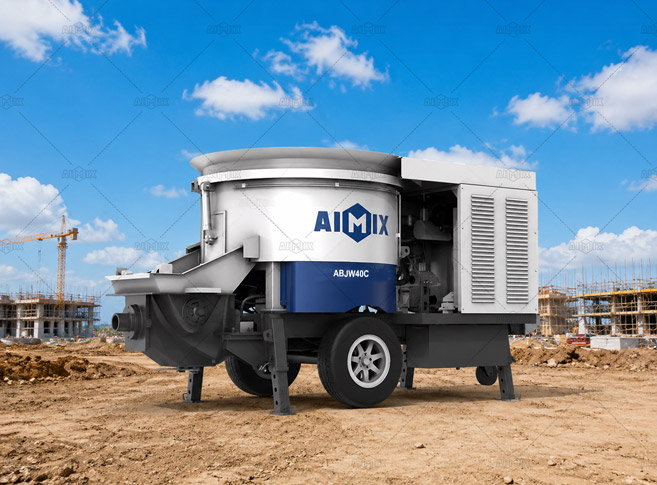
A stationary concrete pump can be more appropriate when the project requires substantial pumping distance or when the pump must remain in one location while concrete is delivered through a fixed pipeline network.
This configuration separates concrete production from concrete placement. A concrete batching plant or mixer truck supplies fresh concrete to the pump, while the pump handles transportation through the pipeline. Such an arrangement can support more demanding strengthening operations where placement points are distributed across several floors or sections of an existing building.
Boom Pump for Elevated Building Strengthening
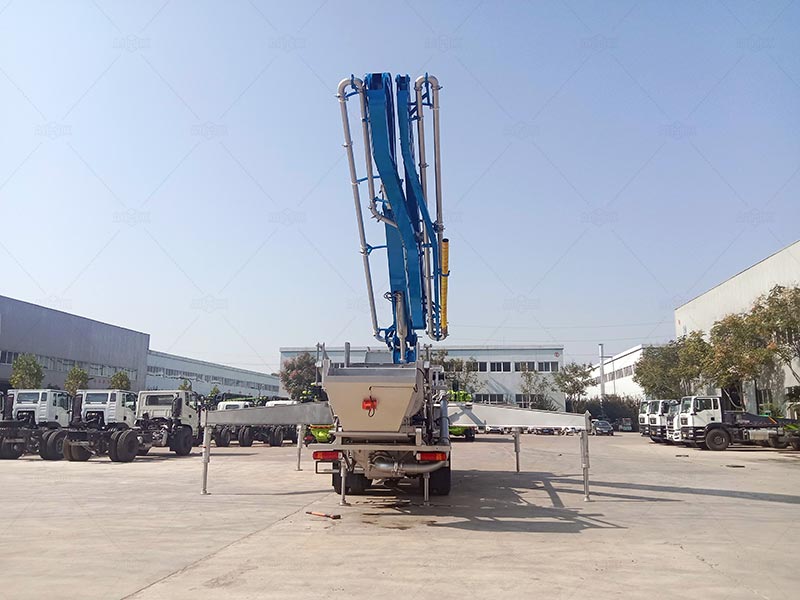
A boom pump provides a different solution. Its articulated boom can position the delivery hose over obstacles and reach elevated placement areas without requiring the entire pipeline to be manually installed through the building.
This capability can make boom pumps attractive for larger structural rehabilitation projects. However, the concrete boom pump price should not be used as a direct benchmark for Kenyan projects because market conditions, taxes, transportation, specifications, and local service costs differ between countries. It can be referenced only as a broader regional equipment-price indicator rather than a precise Kenyan quotation.
How to Evaluate Pumping Costs for Building Strengthening Projects
Match Pump Capacity to the Actual Placement Task
The correct approach is to begin with the placement requirement rather than the machine itself. Important parameters include the required concrete volume, maximum horizontal distance, maximum vertical distance, pipeline diameter, concrete mix characteristics, and expected placement rate.
For example, a small building-strengthening project may benefit from an integrated mixer pump, while a larger multi-story rehabilitation project may justify a stationary pump or boom pump. The most expensive machine is not necessarily the most economical solution.
Consider Labor and Setup Time
Pump pricing should also be evaluated through the lens of project productivity. A system that requires extensive manual pipeline assembly, frequent relocation, or complicated cleaning procedures can increase labor expenditure even when its purchase or rental cost appears attractive.
For strengthening projects with tight working windows, setup time can become particularly consequential. Reducing idle periods helps keep concrete placement synchronized with reinforcement preparation, formwork removal, and structural sequencing.
Account for Concrete Supply Coordination
Pumping equipment cannot operate independently of concrete production. The supply rate must remain compatible with the pump’s effective output. If concrete arrives too slowly, the pump remains underutilized. If concrete arrives faster than the placement team can handle, unnecessary waiting or material-management problems can arise.
For larger projects, a concrete batching plant can provide a controlled source of concrete for the pumping system. For smaller works, ready-mixed concrete or an integrated mixer pump may be more appropriate. The ideal arrangement depends on project duration, concrete volume, access conditions, and the frequency of strengthening operations.
Ultimately, concrete pump pricing for Kenyan building strengthening projects is strongly shaped by placement constraints rather than pump specifications alone. Restricted access, long pipelines, vertical elevation, complicated routing, limited working space, and required output can all alter the equipment configuration and associated costs. A concrete mixer pump can serve compact, localized strengthening tasks, while stationary pumps and boom pumps become more suitable as placement distances, building height, and project scale increase. Evaluating the complete placement system—rather than focusing only on the equipment price—provides a more realistic basis for controlling concrete pumping costs.