In large-scale infrastructure construction—such as bridge engineering, urban rail transit networks, offshore wind farms, and precast concrete casting yards—managing the internal transport and yard storage of heavy, oversized components represents a major portion of project timelines and capital budgets. Concrete box girders, shield tunnel liner segments, structural steel trusses, and wind turbine tower sections present unique handling challenges due to their extreme weight, large physical dimensions, and susceptibility to structural damage if improperly handled.
Traditionally, site managers have relied on a combination of fixed rail-mounted gantry (RMG) cranes, heavy mobile truck cranes, and multi-axle flatbed trailers. However, as modern construction projects face tighter schedules, constrained job sites, and strict cost controls, rubber-tired straddle carriers have become an increasingly popular logistics alternative.
This article provides an objective analysis of how straddle carriers optimize on-site material transport workflows to help lower overall transportation and operational costs across several key dimensions.
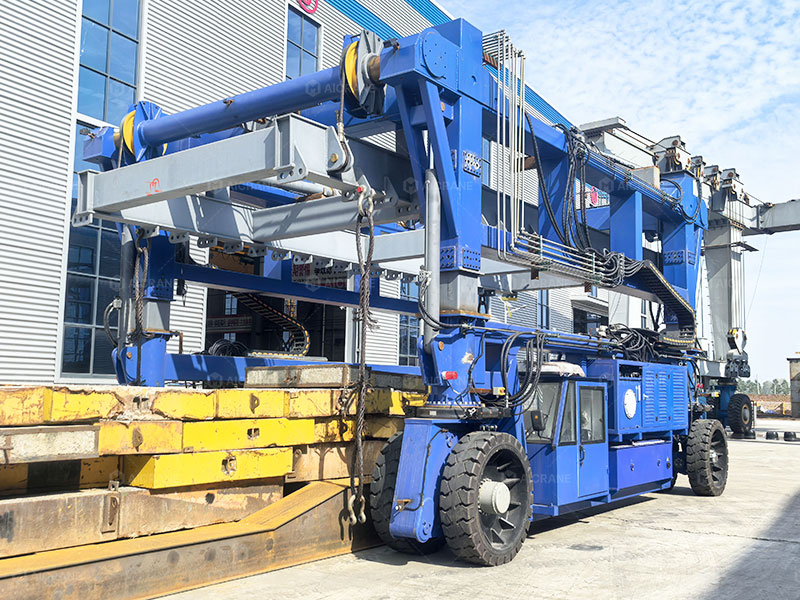
1. Reducing Temporary Site Infrastructure and Civil Works Capital Expenses
Mega infrastructure projects are inherently temporary or semi-permanent in nature. Once construction is complete, job sites must be restored or demobilized. Deploying conventional heavy lifting equipment often requires significant initial capital expenditure (CapEx) for temporary site development:
- Eliminating the Need for Fixed Rail Foundations: Rail mounted gantry cranes require reinforced concrete foundations and heavy steel rail tracks. Constructing these foundations requires substantial lead time, raw materials, and labor, and the infrastructure has negligible salvage value once the project finishes. Rubber-tired straddle carriers, by contrast, utilize large pneumatic or solid rubber tires that distribute heavy loads evenly. They can operate directly on compacted gravel or asphalt surfaces, significantly reducing initial civil engineering costs.
- Maximizing Yard Storage Density: Straddle carriers straddle the load and travel directly over stacked components. Unlike mobile truck cranes, which require broad outrigger deployment zones and wide swing radii, straddle carriers move vertically and longitudinally within narrow aisles. This “straddling” capability allows precast yards and assembly sites to utilize a far more compact layout, increasing storage capacity per square meter and reducing land acquisition or rental costs.
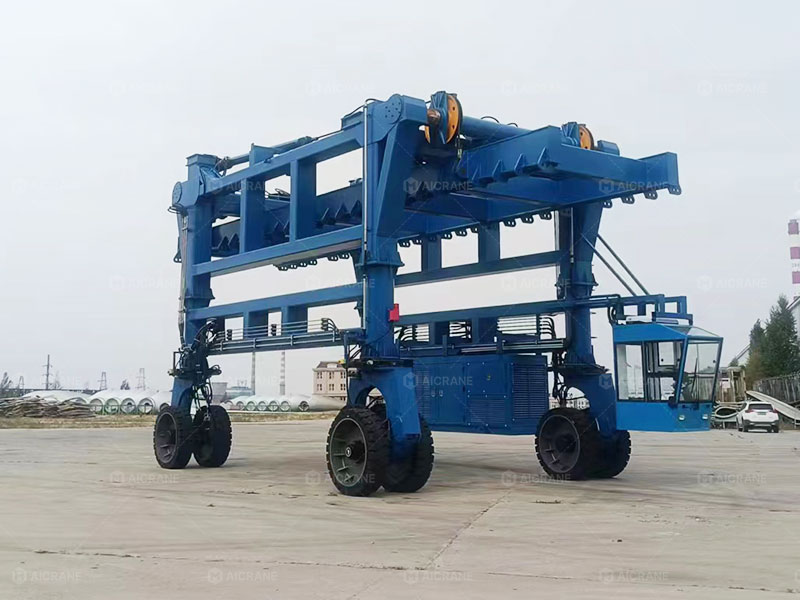
2. “Self-Loading and Self-Unloading” Capabilities to Eliminate Auxiliary Equipment Rentals
In conventional “crane plus tractor-trailer” transport models, moving a component across a job site requires coordinated machinery. Typically, a stationary gantry crane lifts the segment onto a flatbed trailer, the trailer hauls it across the yard, and a second crane unloads it at its destination or staging area.
- Single-Machine Operations: A straddle carrier integrates hoisting, transport, and stacking capabilities into a single mobile machine. One unit can independently lift a component, carry it across the yard, and place it precisely at the target location without requiring auxiliary mobile cranes or secondary transport vehicles.
- Eliminating Equipment Idling and Downtime: Multi-machine logistics chains are prone to bottleneck delays—such as flatbed drivers waiting for a crane to become available, or crane operators idling while waiting for the next trailer to arrive. By consolidating these functions into an independent machine, straddle carriers minimize idle time and cut unnecessary fuel consumption caused by waiting equipment.
3. Accelerating On-Site Turnover Efficiency and Shortening Schedules
Project duration directly impacts indirect costs, including site management overhead, equipment rental rates, and financing expenses. Straddle carriers offer distinct operational speed and maneuvering advantages within job site boundaries:
- High Maneuverability and Small Turning Radii: Modern industrial straddle carriers are equipped with multi-wheel or all-wheel steering systems (including crab steering and zero-turn radius capabilities). This allows them to navigate tight passages, negotiate 90-degree turns in confined yards, and reposition quickly between narrow storage lanes.
- Bi-Directional Travel and Rapid Alignment: Most modern straddle carriers feature elevated, bi-directional operator cabs or rotating seats, allowing the operator to drive forward in either direction without having to turn the entire vehicle around in long, narrow yards. Combined with hydraulic sway control and fine-positioning side-shift mechanisms, this reduces line-up and placement time per component, increasing the daily throughput rate of precast elements.
4. Lowering Direct Labor and Ongoing Maintenance Expenses
Operating costs are heavily driven by labor requirements, energy consumption, and equipment maintenance schedules.
- Streamlining On-Site Crew Sizes: Operating a traditional “crane plus trailer” setup typically requires multiple workers: truck drivers, crane operators, riggers, and ground spotters. Straddle carriers equipped with specialized hydraulic spreaders, automatic locking mechanisms, or remote-controlled rigging attachments allow a single qualified operator (supported by minimal ground staff) to complete the entire pick-and-carry sequence. This lowers total labor requirements and reduces ongoing payroll expenses.
- Consolidated Fleet Maintenance: Maintaining a single mobile straddle carrier engine and hydraulic system is generally less costly and complex than servicing multiple diesel engines across separate mobile cranes and heavy tractors. Furthermore, newer straddle carrier models utilize hybrid diesel-electric or fully electric drive systems. Regenerative braking and hoisting technology can capture kinetic energy during load lowering, reducing overall fuel consumption and operating costs over long shifts.
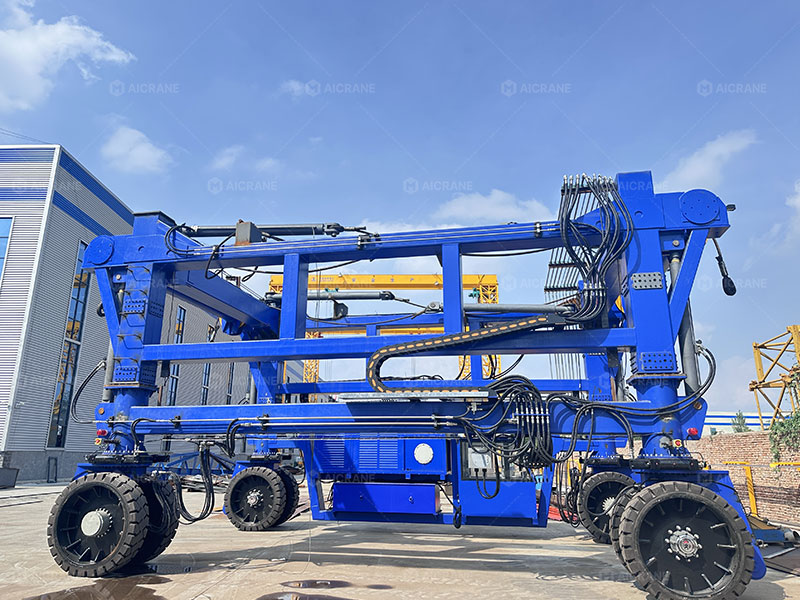
5. Controlling Component Damage Rates and Safety Risk Expenses
Moving structural elements that weigh tens or hundreds of metric tons carries inherent financial risks. Structural cracking, surface chipping, or accidental tipping during transport results in costly rework, project delays, or insurance claims.
- Controlled Hoisting and Active Sway Reduction: Straddle carriers feature rigid or semi-rigid structural frames combined with hydraulic or electronic anti-sway systems. These systems maintain load stability during travel, minimizing pendulum action. This gentle handling is particularly critical for post-tensioned concrete girders and shield segments, which are vulnerable to cracking from sudden dynamic impacts or twisting forces.
- Enhanced Visibility and Integrated Safety Systems: Cab positioning high on the frame provides the operator with an unobstructed view of both the load and the surrounding travel path. Equipped with proximity sensors, cameras, and automatic speed-limiting controls, Aicrane straddle carriers help reduce collision risks in busy construction yards, lowering repair costs and insurance premiums.
6. Comprehensive Cost Comparison Across Logistics Configurations
To illustrate these economic differences, the table below compares key operational characteristics across common material handling setups used in large infrastructure construction:
| Comparison Dimension | Rail-Mounted Gantry (RMG) + Flatbed Trailer | Mobile Truck Crane + Flatbed Trailer | Rubber-Tired Straddle Carrier |
|---|---|---|---|
| Site Preparation Cost | High (requires concrete rail foundations) | Low (requires standard ground compaction) | Moderate/Low (requires compacted yard, no rails) |
| Fleet Equipment Count | 2+ units (RMG crane + site trailer) | 2–3 units (loading/unloading cranes + trailer) | 1 unit (handles loading, transport, unloading) |
| On-Site Labor Demand | High (requires multiple operators & riggers) | High (requires multiple drivers, operators, signalers) | Low (typically 1 operator, minimal ground support) |
| Yard Space Utilization | Restricted to fixed rail span | Low (requires wide outrigger setup space) | High (can travel over and straddle rows) |
| Site Mobilization/Relocation | High (complex assembly & rail dismantling) | Low (drives on public roads) | Moderate (modular breakdown or lowboy transport) |
Note: Actual financial savings depend on specific project parameters, including project duration, component weight and dimensions, land lease rates, and local labor costs.
Conclusion
While straddle carriers are not a universal replacement for all heavy lifting machinery on a construction site, they offer significant cost advantages in applications requiring frequent handling, stacking, and site transport of large, heavy precast elements or structural fabrications.
By integrating hoisting and transport capabilities into a single, mobile chassis, straddle carriers simplify construction site logistics, reduce temporary civil work expenditures, optimize workforce deployment, and minimize equipment idle time. Over the lifecycle of a major infrastructure project, these operational efficiencies translate into measurable reductions in overall transportation costs.