Concrete placement becomes considerably more complicated when a mixer truck can reach the construction site but cannot reach the actual pouring point. This situation is common on projects involving narrow access roads, confined urban plots, uneven terrain, deep foundations, or structures located behind existing buildings. Simply bringing more trucks to the site does not solve the final-delivery problem. The concrete still has to travel from the vehicle to the structure. For Zimbabwe contractors, where projects may range from urban building construction to dispersed infrastructure and remote developments, finding a practical final-placement method can have a direct influence on labor efficiency and construction progress.
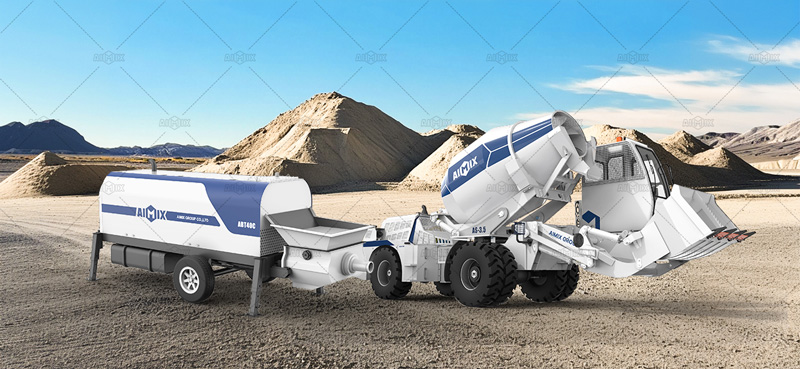
One increasingly useful approach is to combine a self loading concrete mixer with a concrete pump. Instead of treating concrete production and pumping as completely separate operations, the combo can produce concrete closer to the construction area and then transfer it through a pipeline to the pouring point. This configuration shortens the material-handling chain and gives contractors greater independence when conventional mixer trucks cannot provide the final reach required by the project.
Why Truck Access Does Not Always Mean Concrete Placement Access
The Last Few Meters Can Become the Biggest Logistical Challenge
A concrete truck may arrive at a construction site without being able to reach the actual pouring location. The problem can be caused by narrow entrances, soft ground, steep gradients, existing structures, temporary road conditions, or insufficient space for a large vehicle to maneuver.
This creates a gap between concrete delivery and concrete placement.
Workers may attempt to bridge that gap using wheelbarrows, buckets, chutes, or other manual methods. These approaches can work for very small quantities, but they become labor-intensive as concrete volume increases. The longer the distance, the more disruptive the process becomes.
Concrete placement also depends on timing. Fresh concrete should be delivered and placed within an appropriate working period, so excessive manual handling and prolonged transfer can complicate the operation.
Conventional Truck-and-Pump Arrangements May Add Another Layer of Coordination
A conventional arrangement may involve ready-mix trucks delivering concrete to a concrete pump machine positioned at a suitable access point. The pump then transfers the concrete through a pipeline to the final location.
This can be highly effective on large, accessible projects. But on smaller or more remote sites, the arrangement may involve additional transportation, equipment mobilization, and scheduling requirements.
If the truck cannot reach the pump efficiently, or if ready-mix supply is inconsistent, the entire operation can become cumbersome.
The question then changes from “How can the truck reach the pouring point?” to “How can concrete production be brought closer to the work?”
How the Self Loading Concrete Mixer and Concrete Pump Combination Solves the Final-Delivery Problem
Produce Concrete Closer to Where It Is Needed
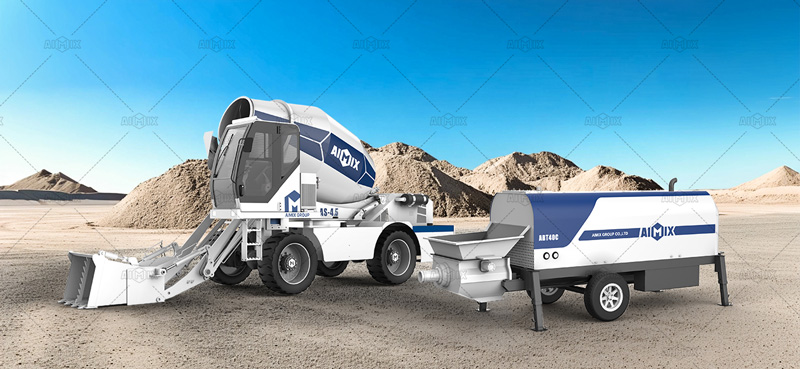
A self loading concrete mixer can load aggregates, combine the required materials, mix the concrete, and transport the fresh mixture around the construction site. When paired with a concrete pump, this creates a more integrated concrete production and placement system.
The self loading concrete mixer for sale in Zimbabwe handles concrete production and short-distance mobility. The concrete pump handles the final transfer through a delivery pipeline.
This combination is particularly useful when the equipment can reach a suitable location near the construction area but cannot physically drive to the exact pouring point.
The pipeline effectively bridges the remaining distance.
From Production to Pumping Without Additional Truck Transfers
The combo can reduce dependence on a separate ready-mix transportation stage. Concrete is produced on demand and can be pumped directly toward the placement area.
This can simplify the workflow:
Material loading → Concrete mixing → Short-distance movement → Pumping → Concrete placement
Instead of coordinating a stationary batching plant, mixer trucks, and a separate pumping operation, contractors can establish a more localized production-and-pumping cycle.
The Combo Is Particularly Relevant to Remote and Restricted Sites
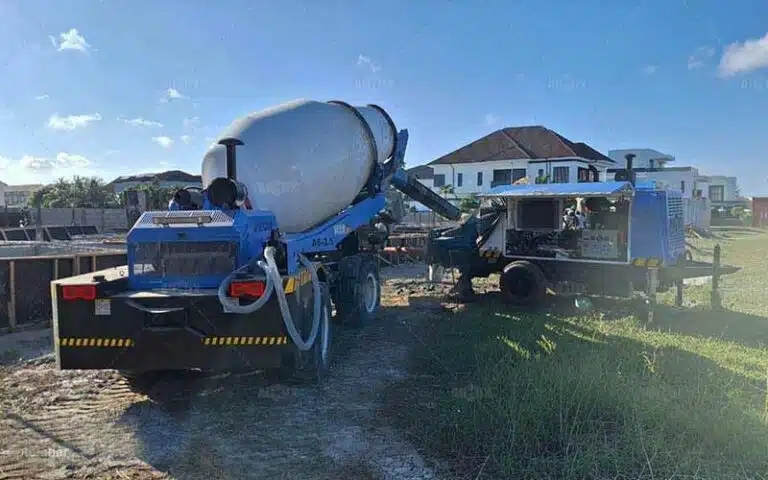
Zimbabwe’s construction landscape includes urban developments as well as projects where infrastructure and access conditions may be less predictable. Remote roads, rural infrastructure projects, agricultural developments, and construction sites far from commercial concrete suppliers can all create concrete logistics challenges.
A self loading concrete mixer provides an independent production capability, while the concrete pump extends the reach of the fresh concrete.
This can be valuable for foundations, retaining walls, culverts, drainage structures, bridge components, floor slabs, and other applications where concrete must be placed beyond the equipment’s immediate position.
Reducing Manual Handling Can Improve the Construction Workflow
Manual concrete transportation requires workers to repeatedly move material from the mixing point toward the placement area. This can consume considerable labor, especially when the distance is long or the terrain is difficult.
A concrete pump mechanizes this transfer.
Once the delivery pipeline has been installed and the concrete mix is suitable for pumping, the material can move continuously toward the required location. Workers can concentrate more heavily on placement, vibration, leveling, and finishing rather than repeatedly transporting concrete.
How Zimbabwe Contractors Can Determine Whether the Combo Is Suitable
Assess Access Conditions Before Choosing the Equipment
The first consideration is not machine capacity. It is the site itself.
Contractors should examine entrance width, ground conditions, gradients, travel distance, available setup space, and the distance between the equipment position and the pouring point.
If the self loading mini concrete mixer for sale can maneuver close enough to the structure while the concrete pump can bridge the remaining distance, the combination can provide a practical solution.
Match Pumping Requirements With the Concrete Mix
Not every concrete mix behaves identically during pumping. Aggregate size, mix proportions, slump, workability, and cement content can affect pumping performance.
The concrete pump should therefore be selected according to the actual project requirements rather than simply the lowest purchase price.
Pipeline length and configuration also matter. Long horizontal runs, substantial vertical lifts, and numerous bends increase resistance and should be incorporated into equipment selection and site planning.
Coordinate Production Rate With Pumping and Placement
The objective is a continuous concrete flow rather than maximum output from one individual machine.
If the self loading concrete mixer produces concrete faster than the placement crew can handle it, the benefit of higher production may be limited. If the concrete pump cannot maintain the required flow, the mixer may spend more time waiting.
A balanced system is therefore essential.
Evaluate the Combination as a Complete Concrete Solution
For Zimbabwe contractors, the value of adopting a self loading concrete mixer and concrete pump combo lies in the integration of functions. The mixer provides mobile concrete production; the pump provides extended delivery; together they create a more direct route from raw materials to the pouring point.
This approach does not make conventional mixer trucks or stationary batching plants obsolete. Large projects with substantial and predictable concrete demand may still benefit from centralized production and truck-based supply.
However, when truck access becomes the limiting factor, the combo can offer a different solution.
The central advantage is flexibility. Concrete can be produced closer to the work, moved around challenging sites, and pumped into locations that are difficult or impossible for trucks to access directly. For projects where the final few meters represent the greatest logistical obstacle, combining a self loading concrete mixer with a concrete pump can turn a fragmented concrete supply process into a more cohesive production-and-pumping workflow.
Ultimately, concrete placement is not simply a question of how much concrete can be produced. It is a question of how efficiently that concrete can travel from raw materials to the exact point where construction requires it. For Zimbabwe contractors facing restricted access, remote sites, or difficult terrain, the right combination of mobile production and pumping can make that final connection considerably easier.