A 100 ton gantry crane can handle many of the heavy precast concrete components used in bridge construction, industrial buildings, infrastructure projects, and large precast yards. Typical applications include precast bridge girders, beams, columns, wall panels, tunnel segments, culverts, concrete slabs, and other large structural elements.
However, a 100 ton lifting capacity does not mean every 100 ton precast component can be lifted safely. The actual working load must include the weight of the concrete component, lifting devices, spreader beams, slings, and other below-the-hook equipment. The required span, lifting height, load center, lifting frequency, and ground or rail conditions also affect the crane configuration.
For this reason, a 100 ton gantry crane is best understood as a heavy-load handling system for a defined operating range rather than simply a crane with a 100 ton nameplate capacity.
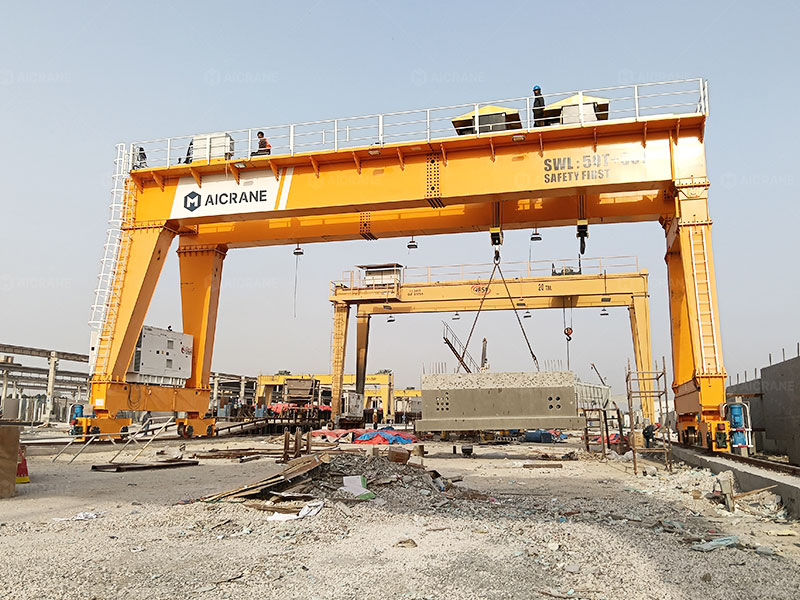
Precast Bridge Girders
Precast bridge girders are one of the clearest applications for a 100 ton gantry crane. Depending on their length, cross-section, reinforcement, concrete density, and design, individual girders can become too heavy for conventional forklifts or smaller overhead lifting equipment.
A 100 ton gantry crane can be used to lift girders from a casting bed, move them through a precast yard, position them on storage supports, or transfer them to a loading area.
For example, a bridge project may produce long prestressed concrete girders that need to be moved after curing. The crane must lift the girder from designated lifting points while maintaining controlled movement along its length. A spreader beam may be required when the lifting points are widely separated or when the girder geometry makes direct sling lifting unsuitable.
The important parameters are not only the girder’s total weight but also its length, lifting points, center of gravity, required lifting height, and required travel path.
A 100 ton crane may therefore be suitable for a 70 ton girder in one project while requiring a different configuration for a shorter but heavier component in another.
Precast Concrete Beams
Precast beams are used in industrial buildings, warehouses, parking structures, bridges, and other concrete structures. Their dimensions vary considerably, so the crane capacity required for beam handling depends on the individual component rather than simply its name.
A 100 ton gantry crane can handle heavy precast beams during several stages:
- Removing beams from casting areas
- Moving beams to temporary storage
- Loading beams for transportation
- Repositioning beams during assembly
- Feeding beams into an installation area
The crane operator also needs to account for the beam’s center of gravity. A long beam may have a relatively high total weight but require carefully controlled lifting because of its length and flexibility.
For repetitive precast production, the crane’s working cycle, travel speed, hoisting speed, and positioning accuracy become important. The crane is not simply moving one beam once; it may repeat similar lifting operations throughout the production day.
Precast Concrete Columns
Large precast concrete columns can also fall within the working range of a 100 ton gantry crane.
Columns used in industrial facilities, power infrastructure, warehouses, parking structures, and large commercial buildings may have substantial dimensions and reinforcement. A crane can lift them from horizontal storage or production positions and place them onto transport equipment or installation supports.
Column handling creates a different challenge from beam handling because the component may need to change orientation during the lifting process.
For example, a column manufactured horizontally may need to be raised into a vertical position. The lifting arrangement must therefore consider the changing center of gravity and the forces generated during rotation.
The gantry crane configuration should be based on the actual lifting procedure rather than the column’s static weight alone.
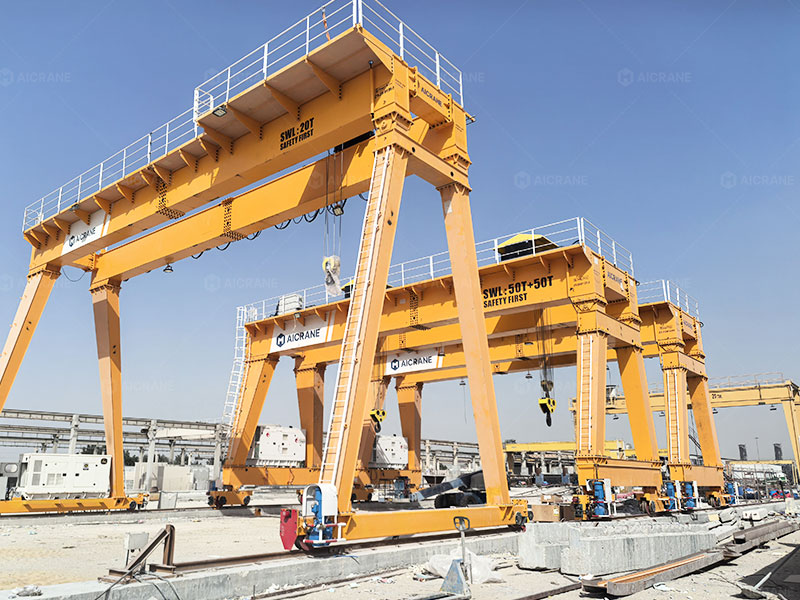
Precast Wall Panels
Large precast wall panels are another potential application.
Structural and architectural precast panels can be wide, long, and relatively thin. Their total weight can be significant even when their thickness is much smaller than that of a beam or column.
A 100 ton gantry crane can move wall panels between casting areas, curing areas, storage zones, and transportation points.
Panel handling requires particular attention to:
- Panel dimensions
- Lifting insert locations
- Center of gravity
- Panel orientation
- Sling angles
- Wind exposure
- Temporary support arrangements
For tall panels, wind can become a practical operational issue even when the load remains well below the crane’s rated capacity. A large panel presents considerably more surface area to the wind than a compact concrete block.
This is why the safe working limit for a particular lifting operation should be established from the project’s engineering requirements rather than from gantry crane capacity alone.
Precast Tunnel Segments
Tunnel construction creates another demanding application for heavy lifting equipment.
Precast tunnel segments are manufactured as curved concrete sections and assembled into complete tunnel rings. Depending on the tunnel diameter, segment dimensions, reinforcement, and design, individual segments can weigh several tonnes or more.
A 100 ton gantry crane can be used in a precast tunnel segment production or storage facility to:
- Remove segments from molds
- Transfer segments between production stations
- Move cured segments to storage
- Load segments onto transport equipment
- Reposition heavy segment assemblies
The curved geometry of tunnel segments makes load positioning important. The lifting system must engage the component at the manufacturer’s designated lifting points and maintain stability during movement.
In a tunnel segment yard, the crane may perform hundreds or thousands of similar lifting cycles over the course of a project. This makes duty classification and component reliability particularly important when selecting the crane.
Precast Box Culverts
Large precast box culverts are commonly used in drainage systems, road infrastructure, underpasses, and water-management projects.
A box culvert may be a relatively compact component compared with a bridge girder, but its reinforced concrete construction can make individual sections very heavy.
A 100 ton gantry crane can handle large culvert sections during production, storage, loading, and installation preparation.
For example, a precast plant may cast several culvert sections of different dimensions. The same gantry crane can move each section between casting beds and storage areas as long as the maximum operating load and required clearances remain within the crane’s design parameters.
The key consideration is the heaviest actual handling load, not the average component weight.
Large Precast Slabs and Structural Panels
Precast floor slabs, roof elements, bridge deck components, and other large concrete panels can also be handled with a 100 ton gantry crane.
Large slabs often have a wide lifting footprint. If the lifting points are positioned incorrectly, the component can experience bending or uneven loading during lifting.
A gantry crane therefore works together with appropriate lifting accessories rather than operating as an isolated machine.
Depending on the component design, the lifting arrangement may include:
- Slings
- Shackles
- Lifting hooks
- Spreader beams
- Lifting beams
- Specialized concrete lifting devices
The total suspended load should include these accessories when checking crane capacity.
Precast Staircases and Heavy Architectural Elements
Precast stair flights, landings, architectural concrete sections, and other building elements can also be handled by a 100 ton gantry crane. These components are generally lighter than major bridge girders, but their irregular shapes can make lifting more complicated.
A large precast staircase, for example, may have an offset center of gravity. The lifting points must be positioned according to the manufacturer’s engineering design to prevent rotation or instability.
For a double girder gantry crane serving multiple types of precast products, the ability to position loads accurately can therefore be just as important as maximum lifting capacity.
How Much of the 100 Ton Capacity Is Actually Usable?
A common mistake is to assume that a 100 ton gantry crane should routinely lift loads weighing exactly 100 tons.
In practical operation, the crane must be selected and operated according to its rated load, lifting configuration, applicable standards, and project-specific engineering requirements. The suspended load may include the concrete component plus lifting accessories.
For example:
Precast component: 92 tons
Spreader beam and lifting accessories: 3 tons
Total suspended load: 95 tons
In this example, the crane is not lifting a 92 ton component in isolation. Its relevant suspended load is approximately 95 tons.
The project engineer must also verify the applicable load combinations, lifting arrangement, duty classification, and safety requirements rather than treating the difference between 95 tons and 100 tons as an automatic operating margin.
What Determines Whether a 100 Ton Gantry Crane Can Handle a Component?
The component’s weight is only the first parameter.
A practical evaluation should consider at least six factors.
1. Total suspended load
Calculate the component weight together with spreader beams, slings, shackles, lifting beams, and other equipment suspended from the crane.
2. Lifting points
The crane must be compatible with the component’s engineered lifting points. Their location affects load distribution and stability.
3. Span
The required gantry span determines the width of the operating area. A wider span may be required when components need to be moved between widely separated storage or production zones.
4. Lifting height
The required hook height must account for the component’s own dimensions, storage supports, transport equipment, and installation clearance.
5. Travel distance
If the crane needs to move heavy precast components across a large yard, the rail or travel system must be designed for the required route and load conditions.
6. Duty cycle
A crane lifting a 90 ton component once a week has a different operating profile from a precast plant lifting 40–80 ton components continuously throughout every working shift.
Why the Same 100 Ton Crane Can Serve Different Precast Applications
The versatility of a 100 ton gantry crane comes from its ability to operate over a defined working area while handling different types of heavy concrete components.
A bridge project may use it primarily for girders. A precast factory may use the same basic capacity for beams, columns, wall panels, and tunnel segments. A large infrastructure yard may use it for culverts, structural sections, and other heavy concrete products.
However, these applications do not necessarily require identical crane configurations.
The span, lifting height, travel speed, power supply, hoist configuration, control system, duty classification, and lifting accessories can all change according to the project.
For example, a precast plant focused on repetitive production may prioritize higher operating efficiency and positioning accuracy. A temporary infrastructure site may place greater emphasis on mobility, site conditions, and the ability to cover several working areas.
100 Ton Gantry Crane Selection for Precast Projects
A 100 ton gantry crane can handle a broad range of heavy precast concrete components, including bridge girders, beams, columns, wall panels, tunnel segments, box culverts, large slabs, staircases, and structural concrete elements.
The correct question is therefore not simply, “Can a 100 ton gantry crane lift this component?”
A more useful engineering question is:
Can the crane safely lift the complete suspended load, at the required lifting points and height, across the required span and travel path, at the required operating frequency?
That distinction is important for infrastructure and precast projects because the same component weight can require very different crane configurations depending on geometry, lifting method, site layout, and production cycle.
For project planning, the component list should first be converted into a lifting profile covering maximum load, typical load, component dimensions, lifting points, hook height, span, travel distance, lifting frequency, and operating environment. The 100 ton gantry crane can then be configured around the actual handling requirements rather than selected only from its nominal capacity.