Ground conditions are a critical operating requirement for a straddle carrier crane because the machine carries heavy loads while traveling, steering, and lifting on its own wheels. The ground does not simply need to support the carrier’s static weight; it must also withstand repeated wheel loads, braking, steering forces, and load-transfer effects without excessive settlement or deformation. In practical terms, a suitable operating surface should have adequate bearing capacity, levelness, drainage, surface condition, and load distribution, with requirements determined by the carrier’s gross weight, wheel configuration, rated capacity, travel speed, and operating environment. Asphalt, reinforced concrete, and properly prepared compacted surfaces may all be suitable for some applications, but the acceptable ground condition varies by carrier design and project. A site should therefore be evaluated against the manufacturer’s wheel loads and operating requirements rather than relying only on the material name of the pavement.
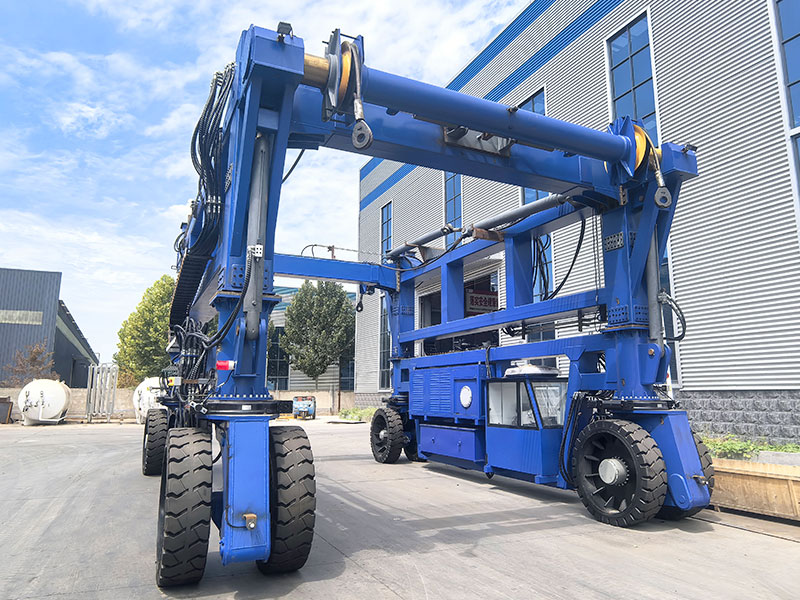
Why Ground Conditions Matter for Straddle Carrier Operation
A straddle crane is different from a conventional crane that transfers loads primarily through fixed rails, runway beams, or foundations. Its rubber tires allow the machine to travel directly across the operating yard.
During operation, the ground must support several loads and forces at the same time:
- The self-weight of the straddle carrier
- The lifted container or other cargo
- Concentrated wheel loads
- Dynamic loads generated during travel
- Braking and acceleration forces
- Steering forces during turning
- Uneven load distribution between wheels
- Repeated traffic over the same travel lanes
The most demanding condition is not necessarily the maximum rated lifting capacity by itself. A carrier may impose significant wheel loads on relatively small contact areas, particularly when carrying a heavy load or traveling over an imperfect surface.
For this reason, ground assessment should consider the complete operating condition rather than asking only whether the yard is “strong enough.”
What Ground Conditions Does a Straddle Carrier Need?
The primary ground requirements for straddle carrier crane operation include sufficient bearing capacity, controlled settlement, appropriate levelness, adequate drainage, and a surface capable of tolerating repeated wheel traffic.
1. Adequate Bearing Capacity
The ground must safely support the rubber tire crane maximum wheel loads without excessive deformation or shear failure.
The required bearing capacity depends on factors such as:
- Rated lifting capacity
- Carrier dead weight
- Number and arrangement of wheels
- Wheel and tire dimensions
- Axle or wheel load distribution
- Load position
- Travel configuration
- Ground construction
- Soil properties
A heavy-duty carrier carrying a full load can impose substantially greater loads than the same machine traveling empty. Therefore, a site that appears adequate during unloaded testing may still require reinforcement for full-load operation.
The correct engineering approach is to obtain the manufacturer’s maximum wheel load or axle load data and compare it with the designed pavement and subgrade capacity.
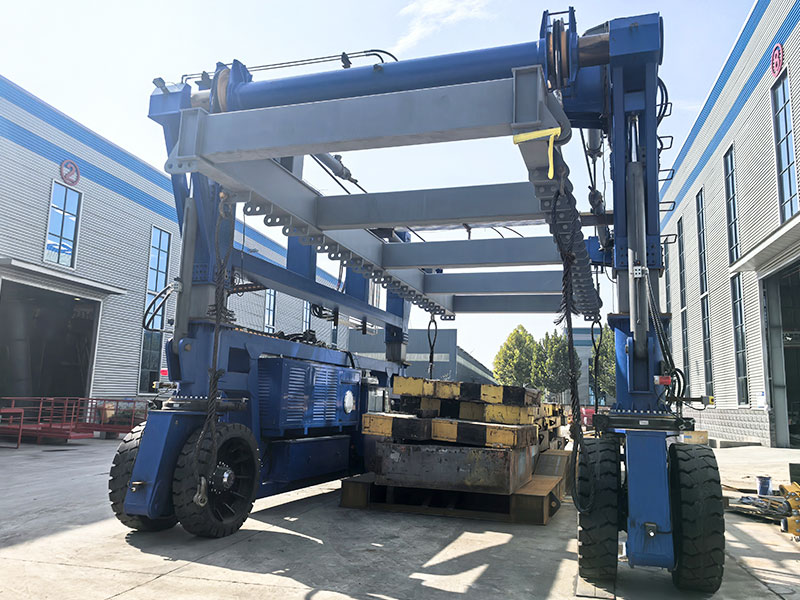
2. Stable and Properly Compacted Subgrade
A strong surface layer alone does not guarantee suitable ground conditions.
If the underlying soil is weak, poorly compacted, saturated, or inconsistent, repeated straddle carrier traffic can cause:
- Rutting
- Differential settlement
- Pavement cracking
- Wheel-path deformation
- Localized depressions
- Loss of levelness
These problems can become more significant when the same travel route is used repeatedly.
For new yards, ground preparation should therefore consider the entire pavement structure, including the subgrade, base course, surface layer, and drainage system.
Where existing ground is being reused, geotechnical investigation and pavement assessment may be necessary before selecting the Aicrane straddle carrier.
How Level Does the Ground Need to Be?
Levelness is important because a straddle carrier has a high center of gravity, particularly when carrying a suspended load.
An uneven surface can cause the carrier body to roll or pitch while traveling. This can affect:
- Load stability
- Tire loading
- Steering behavior
- Structural loading
- Operator visibility
- Travel smoothness
There is no single universal slope or levelness value that applies to every straddle carrier. The allowable longitudinal and transverse gradients should be confirmed from the specific carrier manufacturer’s design requirements.
For example, a carrier designed for controlled operation on prepared asphalt may have different requirements from one intended for more demanding outdoor terrain.
Ground slope should therefore be treated as an equipment-selection parameter, not simply a civil-engineering parameter.
When a project includes sloped areas, operators should also consider how slope affects braking, load handling, steering, and the carrier’s rated operating envelope.
Asphalt, Concrete, or Compacted Ground: Which Surface Is Suitable?
There is no universal rule that straddle carriers must operate only on concrete. The appropriate surface depends on the machine and the project.
Asphalt
Asphalt can be suitable for straddle carrier yards when it is properly designed for the expected wheel loads and traffic frequency.
Its advantages can include:
- Relatively fast construction
- Smooth travel surface
- Easier modification or expansion
- Suitability for outdoor container yards
However, asphalt performance is sensitive to temperature, subgrade condition, pavement thickness, and repeated heavy wheel loading. Heavy concentrated loads can contribute to rutting if the pavement structure is not designed appropriately.
Reinforced Concrete
Concrete can provide a rigid and durable operating surface for high-load applications.
It may be considered where:
- Wheel loads are high
- Traffic is intensive
- Long-term dimensional stability is important
- The project requires a highly controlled surface
However, concrete construction may involve higher initial civil-work requirements, joints, curing time, and more complicated repairs.
Properly Compacted Soil or Gravel-Based Surfaces
Some specialized straddle carrier applications can operate on prepared compacted ground rather than conventional paved yards. Whether this is acceptable depends strongly on the carrier design and site conditions.
The key issue is not simply whether the surface looks hard. The entire ground structure must provide sufficient support under the actual wheel loads.
Uncontrolled loose soil, soft ground, muddy areas, or surfaces with significant rutting should not be assumed to be suitable for heavy straddle carrier operation.
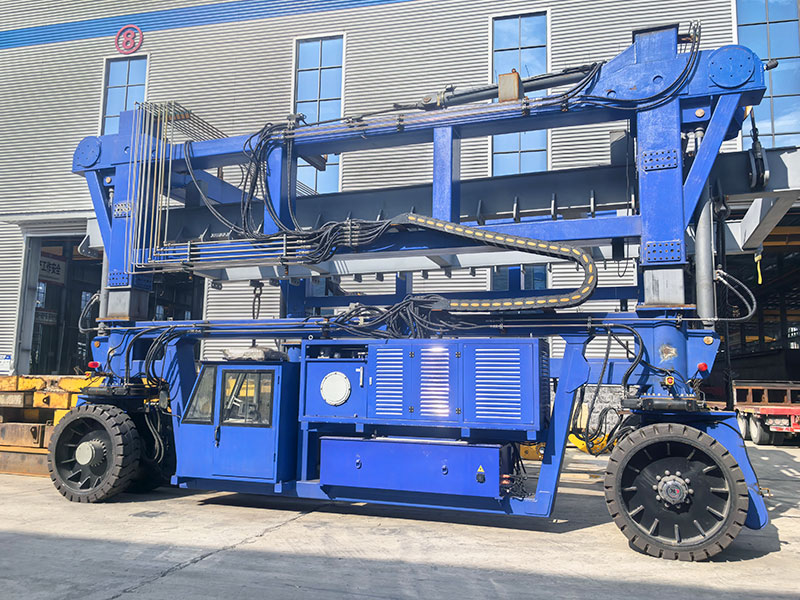
Why Drainage Is an Important Ground Requirement
Water can significantly reduce ground performance, particularly when the subgrade contains moisture-sensitive soils.
Poor drainage can lead to:
- Reduced soil bearing capacity
- Surface deterioration
- Rut formation
- Differential settlement
- Standing water
- Reduced tire-ground traction
Drainage should therefore be considered as part of the operating surface rather than as a separate civil-work issue.
The yard should provide suitable drainage gradients and drainage infrastructure so that rainfall and surface water do not accumulate along the carrier’s normal travel paths.
This is especially important for outdoor yards in regions with heavy rainfall or seasonal wet conditions.
How Ground Conditions Affect Tire Loading and Machine Stability
Rubber tires allow a straddle carrier to move without rails, but they also transfer machine loads directly to the ground.
If one section of the travel path is significantly lower than another, wheel loads may not remain evenly distributed. The resulting load transfer can affect both the tires and structural components.
Repeated operation over damaged or uneven pavement may increase:
- Tire wear
- Suspension loading
- Steering-system stress
- Structural fatigue
- Maintenance requirements
The effect becomes more important as carrier capacity and overall machine weight increase.
For this reason, ground quality should be considered together with the carrier’s wheel arrangement, tire size, steering system, and rated load.
What Should Be Checked Before Installing a Straddle Carrier?
A practical site assessment should be completed before purchasing or commissioning the equipment.
Ground Investigation
Determine the basic characteristics of the existing ground:
- Soil type
- Subgrade condition
- Existing pavement structure
- Groundwater conditions
- Previous settlement
- Drainage performance
For a new facility, these findings can be incorporated into pavement and foundation design. For an existing yard, they help determine whether reinforcement or reconstruction is necessary.
Wheel Load Verification
Ask the equipment supplier for the relevant wheel-load information, including the maximum expected load under the intended operating condition.
The civil engineer can then use this information to verify whether the proposed yard can safely accommodate the carrier.
This is more reliable than specifying a generic ground-bearing value based only on the carrier’s rated lifting capacity.
Surface Inspection
Check for:
- Cracks
- Potholes
- Rutting
- Soft areas
- Uneven joints
- Loose aggregate
- Standing water
- Excessive surface deformation
Small defects that are acceptable for ordinary trucks may become significant when exposed to repeated concentrated wheel loads from a straddle carrier.
Ground Requirements Also Depend on the Operating Pattern
A yard used occasionally is not exposed to the same conditions as a high-throughput container terminal.
Important operating variables include:
Traffic frequency: Repeated travel over the same lane increases cumulative pavement loading.
Travel route: Fixed travel corridors may require greater attention because wheel loads repeatedly act on the same areas.
Load condition: Empty and fully loaded operation produce different wheel-load conditions.
Turning frequency: Tight turns introduce additional lateral forces and tire scrubbing.
Travel speed: Higher speeds can increase dynamic effects when the surface is uneven.
Environmental conditions: Rain, snow, freezing temperatures, high temperatures, and groundwater can affect pavement performance.
Consequently, the ground requirement should be developed from the actual operating profile rather than from a generic “straddle carrier ground requirement.”
What Happens If the Ground Is Not Suitable?
Operating a straddle carrier on inadequate ground can create both immediate and long-term problems.
A soft section may cause localized settlement, while an uneven pavement can increase machine vibration and wheel-load variation. Poor drainage can progressively weaken the subgrade. Over time, these conditions may increase tire and component wear and make the travel route increasingly difficult to maintain.
More importantly, ground deformation can affect load stability and operating safety.
If unsuitable conditions are identified, possible engineering measures may include:
- Improving and compacting the subgrade
- Increasing pavement thickness
- Adding or improving base-course layers
- Reinforcing the surface
- Improving drainage
- Repairing localized weak zones
- Restricting certain travel or loading areas
- Selecting equipment designed for the actual site conditions
The appropriate solution should be determined through engineering assessment rather than simply increasing surface thickness without understanding the underlying soil problem.
How to Match a Straddle Carrier to Existing Ground Conditions
For an existing yard, equipment selection should start with the site rather than the machine.
A practical sequence is:
- Define the required lifting capacity and cargo type.
- Determine the carrier’s gross operating weight.
- Obtain maximum wheel or axle loads from the gantry crane manufacturer.
- Measure the existing pavement and assess the subgrade.
- Check longitudinal and transverse slopes.
- Evaluate drainage and seasonal ground conditions.
- Compare the site’s actual condition with the manufacturer’s operating limits.
- Determine whether ground improvement is required.
- Confirm the final carrier configuration with the equipment supplier and civil engineer.
This approach prevents a common procurement mistake: selecting a carrier based only on lifting capacity and discovering later that the existing yard requires substantial reconstruction.
Ground Requirements for Different Straddle Carrier Applications
Ground requirements can vary significantly according to application.
A container terminal with intensive repetitive traffic generally places higher demands on pavement durability and maintenance than a lower-frequency industrial yard.
A shipyard or heavy fabrication facility may also have unusual requirements because the carrier may handle large loads over outdoor surfaces that were not originally designed for container-handling equipment.
For applications involving uneven or less-developed ground, buyers should specifically ask whether the proposed carrier is designed for those conditions and what limitations apply.
For example, a rubber-tired straddle carrier intended for prepared industrial yards should not automatically be assumed suitable for soft construction-site terrain simply because it does not require rails.
Frequently Asked Questions About Straddle Carrier Ground Requirements
Can a straddle carrier operate on asphalt?
Yes, provided that the asphalt pavement and underlying subgrade are designed or verified for the carrier’s actual wheel loads and operating frequency. Asphalt suitability is therefore project-specific rather than universal.
Does a straddle carrier need concrete ground?
Not necessarily. Concrete is one possible surface solution, but properly engineered asphalt or other prepared surfaces may also be suitable depending on the carrier and application.
Can a straddle carrier operate on uneven ground?
Only within the operating limits specified for the particular carrier. Excessive unevenness, rutting, or slope can affect stability, wheel loading, steering, and safe operation.
Can straddle carriers operate on compacted soil?
Some carrier configurations and applications may allow operation on properly prepared compacted ground. This must be confirmed against the manufacturer’s requirements and the site’s actual soil and drainage conditions.
What ground data should buyers request from a manufacturer?
At minimum, buyers should request maximum wheel or axle loads, overall machine weight, wheel configuration, allowable ground slope, required surface conditions, and any limitations related to loaded travel or turning.
Final Considerations for Buyers and Engineers
The ground requirements for straddle carrier crane operation should be treated as part of the complete equipment-and-site design. The key factors are wheel loading, subgrade strength, pavement structure, levelness, drainage, traffic frequency, slope, and the carrier’s operating configuration.
The most important point is that there is no single ground specification that applies to every straddle carrier. A 40-ton carrier, an 80-ton carrier, and a specialized heavy-load carrier can impose substantially different demands on the yard. Similarly, a low-frequency industrial application and a high-cycle container yard require different pavement considerations.
Before purchasing equipment, obtain the manufacturer’s actual wheel-load and operating requirements and have the proposed travel area checked against those values. This allows the buyer to determine whether the existing ground is suitable, whether targeted improvements are needed, or whether the carrier configuration itself should be adapted to the site.