A 30 ton gantry crane is suitable for many precast concrete operations, but selecting one should not be based on lifting capacity alone. The crane must match the weight and dimensions of precast elements, required lifting height, span, travel distance, duty cycle, ground conditions, and lifting method. For a precast yard, a 30 ton crane may handle products such as beams, wall panels, columns, pipes, slabs, and other large concrete components, provided the actual lifted load—including lifting devices—is within the crane’s rated capacity. The key selection question is therefore not simply “Is 30 tons enough?” but whether a 30 ton gantry crane provides adequate capacity, working range, stability, and operational efficiency for the entire handling process.
What Does a 30 Ton Gantry Crane Mean for Precast Concrete Handling?
A 30 ton gantry crane has a nominal 30,000 kg rated lifting capacity under its specified operating conditions. This rating normally applies to the crane’s hoisting system and must not be interpreted as the allowable weight of every possible load configuration.
For precast concrete applications, the actual lifting load can include:
- Precast concrete product
- Lifting beams or spreader beams
- Slings
- Shackles
- Hooks and other rigging equipment
- Special lifting frames or clamps
For example, if a precast component weighs 28 tons and the lifting arrangement adds 1 ton of rigging equipment, a nominal 30 ton crane leaves only 1 ton of rated capacity. That provides little margin for variations in the actual load or lifting configuration.
The crane should therefore be selected from the maximum verified lifted load, rather than the average weight of products handled in the yard.
What Precast Products Can a 30 Ton Gantry Crane Handle?
The appropriate application depends on the actual weight and geometry of the concrete products rather than the product category itself.
A 30 ton crane may be used for handling:
- Precast concrete beams
- Bridge components
- Wall panels
- Columns
- Floor slabs
- Concrete pipes
- Box culverts
- Structural frames
- Precast stairs
- Large molds and formwork
However, the dimensions of a precast component can be as important as its weight.
A long beam may weigh less than 30 tons but require a wide lifting arrangement and sufficient hook height. A large wall panel may have a relatively moderate mass but present a significant wind or stability consideration during handling.
For this reason, load weight, load dimensions, center of gravity, lifting points, and lifting orientation should be evaluated together.
How Should You Determine Whether 30 Tons Is Enough?
Start with the heaviest load that the crane will actually lift.
A practical calculation is:
Required lifting capacity ≥ maximum load weight + lifting accessories
For example:
| Item | Example load |
|---|---|
| Maximum precast component | 27 t |
| Spreader beam | 0.8 t |
| Slings and shackles | 0.2 t |
| Total lifted load | 28 t |
In this example, a 30 ton crane has a nominal 2 ton difference between rated capacity and the calculated lifted load.
Whether that is appropriate depends on the applicable crane design standard, load chart, lifting arrangement, operating conditions, and project requirements. A buyer should not independently treat the remaining capacity as a universal “safety margin.”
If the project frequently handles loads close to 30 tons, it may be appropriate to evaluate a higher-capacity crane rather than routinely operating a 30 ton crane near its rated limit.
Which Gantry Crane Configuration Is Suitable for a Precast Yard?
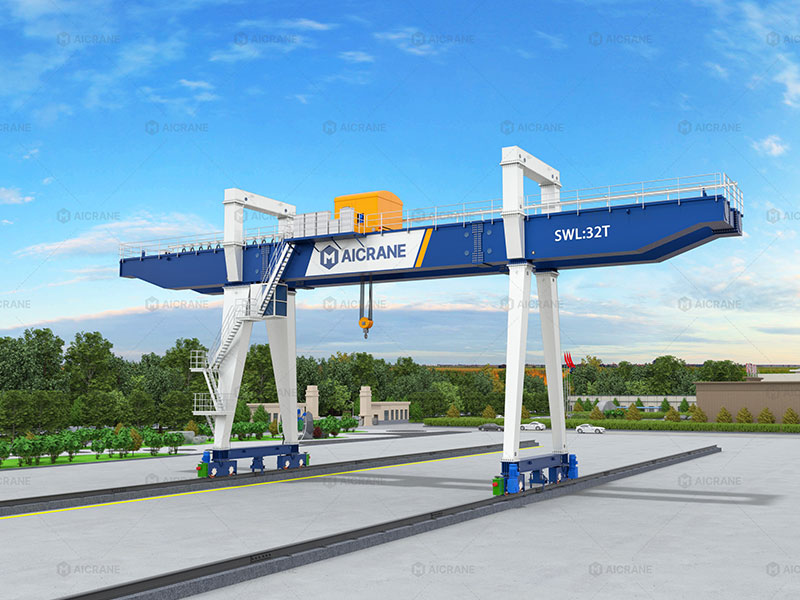
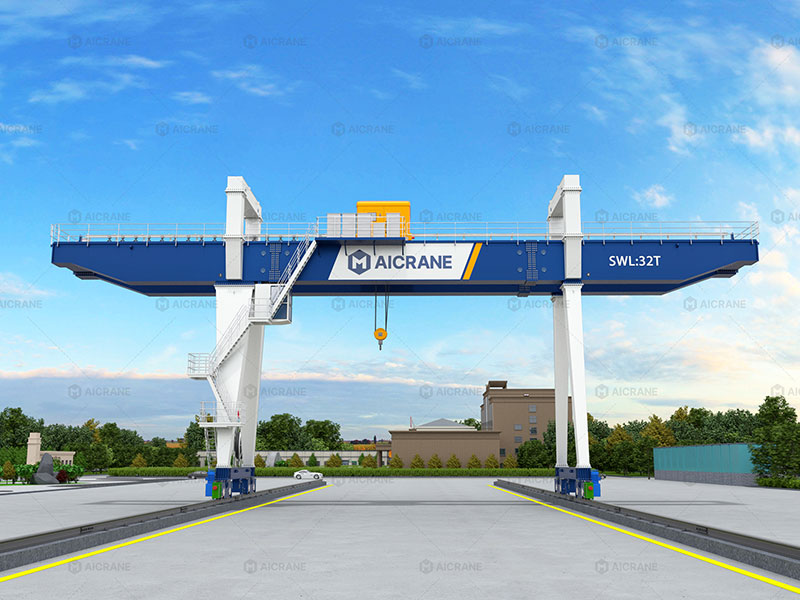
A gantry crane for precast concrete generally consists of a bridge structure supported by legs, with an electric hoist or trolley moving along the bridge. The complete crane can travel along ground-mounted rails.
A typical configuration includes:
- 30 ton rated capacity
- Double-girder bridge
- Electric wire rope hoist
- Motorized long-travel mechanism
- Cross-travel trolley
- Pendant or wireless/radio control
- Rail-mounted supporting legs
- Limit switches and overload protection
For a 30 ton industrial gantry crane, a double-girder configuration is commonly considered when the application requires substantial lifting capacity, span, lifting height, and industrial duty.
The exact configuration should nevertheless be determined from the required span, lift, duty classification, load geometry, and applicable design standard.
Why Does Crane Span Matter?
The span is the horizontal distance between the crane’s supporting rails. It determines how much working area is available beneath the crane.
For precast yards, the span should account for:
- Width of the production area
- Width of storage zones
- Vehicle access
- Mold or casting-bed dimensions
- Required clearance from buildings and structures
- Load rotation and positioning requirements
For example, if precast components are manufactured in parallel casting beds, the crane span needs to cover the beds and the required handling area.
A crane that is too narrow may require additional repositioning of products. A crane that is unnecessarily wide can increase structural and foundation requirements.
The correct span is therefore based on the actual plant layout, not simply the largest available crane span.
How Much Lifting Height Does a Precast Crane Need?
Lifting height should be determined from the complete vertical movement required.
Consider:
- Height of the precast product
- Trailer or transport vehicle height
- Storage height
- Mold height
- Required clearance above obstacles
- Hook approach
- Required clearance during travel
For example, lifting a large precast beam from a low casting bed onto a trailer may require considerably more hook travel than moving products between adjacent storage positions.
Buyers should specify required hook lifting height rather than simply asking for the crane’s overall structural height.
The distinction is important because the crane’s total height and the hook’s usable lifting height are different measurements.
What Duty Classification Should Be Considered?
A precast yard can have very different operating patterns.
One facility may lift a few components each day. Another may continuously move concrete elements between casting, storage, inspection, and loading areas.
Duty classification should therefore be determined from:
- Number of lifting cycles
- Average load percentage
- Maximum load frequency
- Operating hours per day
- Operating days per year
- Travel distances
- Acceleration and braking frequency
A crane repeatedly lifting near its maximum capacity requires a different engineering assessment from a crane that occasionally lifts a heavy component while spending most of its operating time handling lighter products.
The duty classification should be specified by the crane designer according to the applicable standard rather than selected only from a generic capacity table.
How Does the Lifting Method Affect Crane Selection?
Precast concrete components are normally designed with defined lifting points or embedded lifting devices. The crane must work with the approved lifting arrangement.
Common equipment includes:
- Slings
- Shackles
- Spreader beams
- Lifting beams
- Concrete lifting anchors
- Specialized lifting frames
A spreader beam can be useful for long beams and panels because it helps distribute lifting forces and maintain the required sling geometry.
However, the lifting accessory itself contributes to the suspended load and reduces the available gantry crane capacity.
The buyer should therefore provide the crane supplier with information about the lifting points, sling arrangement, product dimensions, and center of gravity before finalizing the crane specification.
What Ground Conditions Are Important for a 30 Ton Gantry Crane?
A rail-mounted gantry crane transfers its wheel loads to the supporting rails and foundations. Ground and foundation conditions therefore form part of the crane selection process.
The project should evaluate:
- Rail foundation design
- Ground bearing capacity
- Rail alignment
- Rail gauge
- Drainage
- Settlement risk
- Outdoor environmental conditions
- Vehicle and pedestrian traffic around the crane
A crane’s rated capacity does not describe the capacity of the ground beneath it.
For an outdoor precast yard, drainage and surface conditions are particularly important. Water accumulation, uneven settlement, or rail misalignment can affect crane travel and maintenance requirements.
Foundation and rail design should be coordinated with the crane’s calculated wheel loads and the civil engineering design.
Outdoor or Indoor: What Changes?
Precast concrete production may take place inside a factory, beneath a covered production area, or outdoors.
An outdoor 30 ton gantry crane may require additional consideration of:
Wind
Outdoor cranes are exposed to wind during both operation and non-operating conditions. Wind loads influence structural design and parking arrangements.
Rain and Dust
Electrical equipment, motors, controls, and enclosures may require protection appropriate to the environment.
Temperature
The required operating temperature range should be specified, especially for projects in regions with severe winter or summer conditions.
Corrosion
Coating systems and electrical protection should reflect the local environment, particularly in coastal or chemically aggressive areas.
These factors should be included in the technical specification rather than treated as afterthoughts.
How Should Travel Speed Be Selected?
The crane has two principal horizontal movements:
- Long travel: movement of the complete gantry along the rails
- Cross travel: movement of the trolley along the bridge
Hoisting speed controls how quickly a component can be raised or lowered. Travel speeds influence positioning time and overall handling productivity.
For precast yards, extremely high speeds are not automatically beneficial. Heavy concrete components require controlled acceleration, braking, positioning, and load stabilization.
A practical system should provide enough speed for the required production rate while maintaining controllable movements during final positioning.
Variable-frequency drives can be used on crane motions where precise acceleration and braking are required, depending on the crane design and project specification.
What Safety Features Should a 30 Ton Gantry Crane Have?
Safety requirements vary according to the applicable standards and project jurisdiction, but a specification for a heavy-duty precast crane should address appropriate protective systems.
Potential features include:
- Overload protection
- Upper and lower hoist limits
- Long-travel limits
- Cross-travel limits
- Emergency stop
- Crane travel warning devices
- Anti-collision protection where multiple cranes operate in the same area
- Rail clamps or storm anchoring for outdoor gantry cranes where required
- Emergency lighting or other site-specific provisions
- Clearly marked rated capacity
Operational safety also depends on procedures.
Operators should know the load weight, approved lifting points, rigging arrangement, travel route, and exclusion zone before lifting. A 30 ton crane should never be treated as having unlimited capacity simply because the load is below 30 tons.
What Should Buyers Include in a 30 Ton Gantry Crane RFQ?
A detailed RFQ helps prevent repeated clarification and specification changes.
At minimum, provide:
Crane capacity: 30 tons
Application: precast concrete handling
Crane type: gantry crane
Span: required rail-to-rail distance
Lifting height: required hook height
Travel distance: total crane runway length
Working environment: indoor or outdoor
Duty cycle: lifting frequency and operating hours
Power supply: site voltage and frequency
Load dimensions: maximum length, width, and height
Maximum load: heaviest complete lifted load
Lifting method: slings, spreader beam, lifting frame, etc.
Site conditions: temperature, wind, dust, corrosion, and ground conditions
Control method: pendant, radio remote, cabin, or specified combination
Applicable standard: required national or international crane standard
Drawings of the precast components and the yard layout are especially useful when determining span, hook approach, travel range, and lifting height.
How Can You Avoid Oversizing or Undersizing the Crane?
There are two common mistakes.
Undersizing
A crane selected too close to the actual maximum load may have limited flexibility for future production changes. It can also make lifting accessories and unusual load configurations more difficult to accommodate.
Oversizing
A substantially oversized crane can increase the cost and structural requirements of the bridge, legs, rails, foundations, electrical system, and supporting structure.
The objective is therefore not simply to select the largest available crane.
A better approach is to establish the maximum lifted load, load spectrum, dimensions, working envelope, duty cycle, and future handling requirements, then engineer the crane around those conditions.
30 Ton Gantry Crane Cost: What Determines the Price?
The price of a 30 ton gantry crane cannot be determined from capacity alone.
Major cost factors include:
- Single- or double-girder configuration
- Span
- Lifting height
- Runway length
- Hoist and trolley configuration
- Duty classification
- Travel speeds
- Control system
- Electrical specification
- Outdoor protection
- Structural steel requirements
- Rail and foundation requirements
- Installation
- Testing and commissioning
- Transportation and site conditions
A 30 ton crane with a short span and modest lifting height can have very different project costs from a 30 ton crane designed for a long outdoor runway and intensive precast production.
For procurement, it is therefore more useful to request a complete technical and commercial quotation based on the project parameters than to compare capacity-only prices.
Key Takeaways
- A 30 ton gantry crane can be suitable for many precast concrete handling applications, but capacity alone does not determine suitability.
- Calculate the maximum complete suspended load, including lifting beams, slings, shackles, and other accessories.
- Evaluate span, lifting height, travel distance, load dimensions, center of gravity, and lifting points together.
- A double-girder configuration is commonly considered for demanding 30 ton industrial applications, but the final design depends on project requirements.
- Duty classification should reflect actual lifting frequency, load spectrum, operating hours, and working conditions.
- Outdoor precast yards require additional consideration of wind, weather protection, corrosion, rails, foundations, and storm conditions.
- The crane RFQ should include the maximum load, dimensions, lifting arrangement, layout, power supply, environment, duty cycle, and applicable standards.
- The right 30 ton gantry crane is the one engineered around the actual precast handling process and site conditions, rather than simply the nominal lifting capacity.