In modern urban infrastructure development and heavy industrial installation projects, construction sites are increasingly characterized by significant physical constraints. When a project demands the deployment of a 50-ton gantry crane within a high-density environment, the margin for error diminishes drastically. For site managers and crane operators, navigating this restricted space is not merely a task of lifting; it is a complex engineering challenge that requires precision, spatial awareness, and rigorous hazard mitigation.
This article provides a technical framework for managing 50 ton gantry crane operations in confined environments, focusing on site engineering, load control, team communication, and the utilization of modern smart-lifting technology.
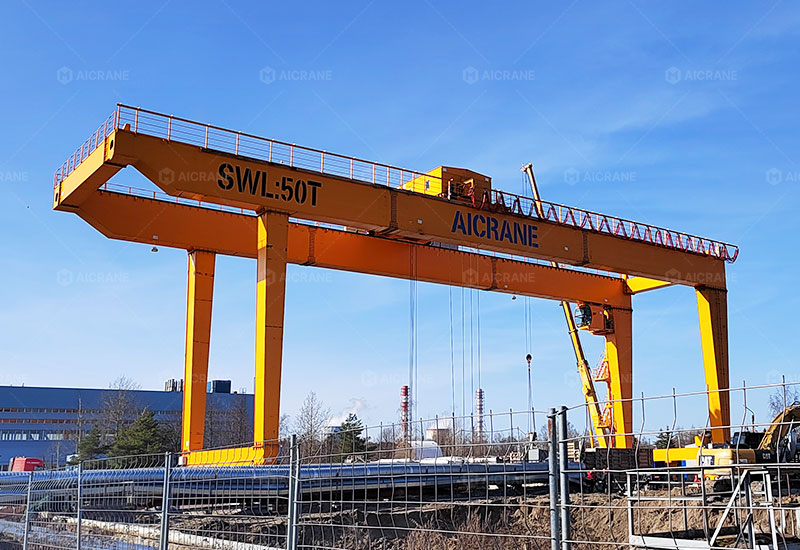
1. Site Engineering and Spatial Planning
Before a 50-ton gantry crane is mobilized, the preparation of the operational site is the most critical factor in ensuring success. In confined areas, the physical dimensions of the equipment relative to the available workspace create significant operational challenges.
Ground Bearing Capacity and Surface Stabilization
A 50-ton crane exerts significant concentrated pressure on the ground. In confined urban sites, the surface is often a composite of basement slabs, utility-laden soil, or temporary backfill.
- Geotechnical Assessment: It is non-negotiable to conduct a geotechnical survey specifically for the crane’s travel path. Underestimating ground density can lead to differential settlement, which, at 50 tons, can tilt the gantry, potentially causing a structural collapse or load instability.
- Load Distribution: Use industrial-grade steel plates or heavy duty gantry crane mats. These must be engineered to distribute wheel pressure over a wider surface area. In tight quarters, ensure these mats are secured to prevent lateral shifting during heavy lifting maneuvers.
- Leveling Precision: Track installation must be verified with laser-leveling equipment. In constrained spaces, even a minor deviation in track elevation is amplified as the crane gains height, which can severely compromise the lateral stability of the lift.
Spatial Envelope Mapping
Site managers must map the “Operational Envelope”—the three-dimensional space that the crane and the load will occupy at all times.
- Virtual Modeling: Use site surveying equipment to create a digital twin of the crane within the site geometry. Identify fixed obstacles such as power lines, adjacent structural columns, and scaffolding.
- Physical Zoning: In high-risk environments, install physical limit blocks on the rails. These serve as a last-resort mechanical safeguard to prevent the gantry from traveling into zones where collision with surrounding infrastructure is inevitable.
2. Advanced Load Control and Precision Lifting
Operating at a 50-ton capacity requires strict management of dynamic forces. In confined spaces, the inertia of a swinging load can lead to catastrophic damage to both the gantry crane and the surrounding environment.
Managing Dynamic Loads and Inertia
- Variable Frequency Drive (VFD) Calibration: Utilize VFD systems to control acceleration and deceleration ramps. In tight sites, an abrupt stop is prohibited; the resulting “pendulum effect” is the primary cause of collisions in restricted areas.
- Vector Rigging: Multi-point rigging is required to eliminate degrees of freedom. Calculate sling angles with precision to ensure the load remains “dead-center.” If a 50-ton load is permitted even a slight deviation, the horizontal forces acting on the gantry legs increase, potentially exceeding the design limits of the crane.
Strategic Tag-Line Utilization
- Non-Elastic Control: Utilize high-strength, non-elastic tag lines. Elastic lines allow for unpredictable load bounce.
- Multi-Point Guidance: At least two tag lines should be manned by experienced riggers, even if the lift appears straightforward. In narrow corridors where wind tunnel effects occur between high-rise structures, the tag-line team must be ready to exert counter-tension to stabilize the load immediately upon lifting.
3. Communication Protocols: The “One-Voice” Rule
When the operator’s line of sight is obstructed by structural steel or building facades, the crane becomes an extension of the signal person. Miscommunication is the leading cause of site accidents.
- Dedicated Communication Channels: The crane team must use a dedicated, interference-free industrial radio channel. All non-essential chatter is banned.
- Absolute Authority of the “Stop” Command: Every person on the lift team, from the rigger to the safety supervisor, must have the authority to initiate an emergency “STOP.” The operator must prioritize this command over all others.
- Redundant Signaling: If radio signals are weak or suffer from interference due to dense concrete/steel surroundings, the team must revert to internationally recognized hand signals. The operation must freeze instantly if the primary and secondary communication channels are compromised.
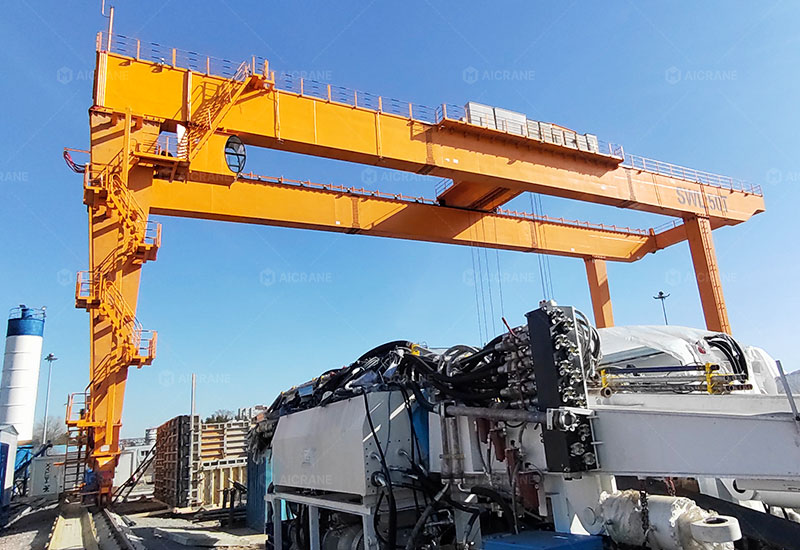
4. Technical Integration: Smart-Lifting Systems
The integration of digital safety systems is mandatory for 50-ton gantry operations in 2026. These systems serve as the digital conscience of the heavy industrial gantry crane operation.
Electronic Limiters and Geo-Fencing
Modern 50-ton cranes are equipped with PLC-based systems that allow for “No-Fly Zones.”
- Virtual Fencing: Before the shift, define the maximum allowable travel limit for the hoist and trolley. If the system detects the hook assembly approaching a virtual barrier, it will automatically throttle the speed or stop movement entirely.
- Anti-Sway Technology: Implement active sway control. These systems use sensors to detect load movement and automatically adjust the hoist speed to counteract the oscillation, effectively keeping the 50-ton load stationary even during rapid maneuvering.
Load Moment Indicators (LMI)
The LMI provides real-time, high-fidelity data on load weight, radius, and boom angle. In restricted spaces, operators often feel pressured to “push” the crane to its limit. The LMI is the ultimate check against this pressure. Even if the lift is within the 50-ton capacity, the LMI helps the operator monitor the dynamic stability of the unit relative to the wind and ground conditions.
5. Maintenance and Proactive Safety
In confined environments, equipment failure is significantly more difficult to address because there is no room to maneuver service vehicles or mobile cranes for repairs.
- Pre-Shift Rigor: Daily checks must focus on the brake systems and electronic limit switches. These components are the first line of defense against accidents.
- Lubrication and Seal Checks: Ensure the pulley and hook block mechanisms are fully lubricated. If a load “jerks” due to a sticky pulley while lifting in a tight space, the oscillation risk is magnified.
- Emergency Scenario Drills: Before the first heavy lift of the project, conduct a team drill on emergency procedures. What is the protocol if the power fails while the load is suspended? Where is the manual brake release? Everyone must know the answer before the load ever leaves the ground.
Conclusion
Operating a 50-ton gantry crane in a confined construction site requires shifting from a mindset of “lifting capability” to “operational engineering.” It is a delicate balance of ground support, dynamic load control, digital safety, and precise human coordination.
The successful operation of heavy lifting equipment in restricted environments relies on the discipline of the entire crew. By adhering to standardized protocols and leveraging modern diagnostic and safety technologies, engineering firms can mitigate the inherent risks of urban construction, turning space constraints into manageable operational variables. Safety is not a static result; it is the continuous application of professional standards to every lift, every shift, and every site.