Straddle carrier container handling cycle time is the time required for a straddle carrier to complete one container-handling sequence, including travel, positioning, container pickup, lifting, transportation, set-down, and repositioning for the next task. The actual cycle time depends on much more than the carrier’s rated travel or hoisting speed. Travel distance, stacking height, container weight, spreader operation, acceleration, traffic, yard layout, and waiting time can all affect productivity.
For terminal planners and equipment buyers, the key is to evaluate the complete handling cycle under actual operating conditions. A carrier with high travel speed may not deliver the shortest overall cycle if it spends significant time positioning, waiting, or traveling through congested areas.
What Is Straddle Carrier Container Handling Cycle Time?
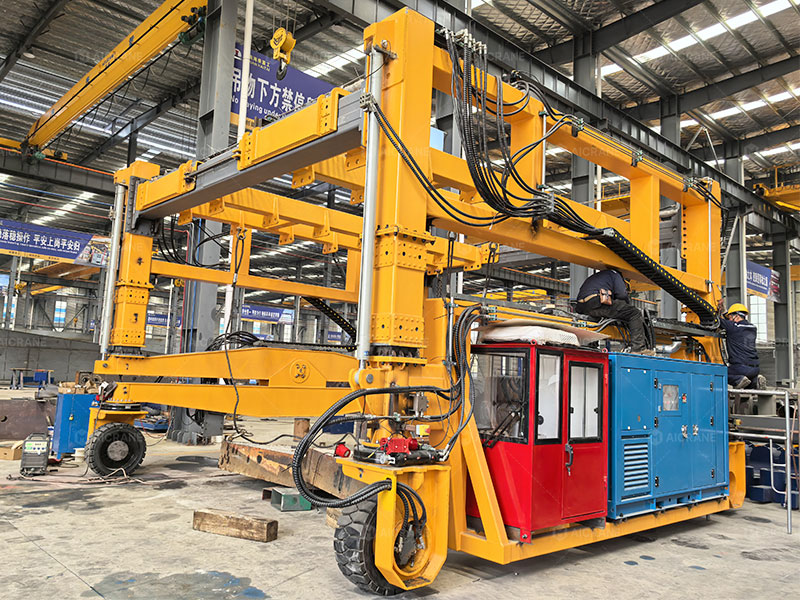
A container straddle carrier cycle is the sequence required to complete one container movement.
A typical operation may include:
- Traveling to the container.
- Positioning the straddle carrier above the container.
- Lowering the spreader.
- Locking the spreader onto the container.
- Hoisting the container.
- Traveling to the destination.
- Positioning the container over the receiving location.
- Lowering and releasing the container.
- Moving away or proceeding to the next assigned task.
This makes straddle carrier container handling cycle time a combination of several movement and handling operations rather than a single equipment specification.
A simplified calculation is:
Cycle time = travel time + positioning time + spreader operation time + lifting/lowering time + waiting time + other delays
The exact sequence varies according to terminal layout, stacking method, container flow, and operating procedure.
What Equipment Is Involved in a Straddle Carrier Handling Cycle?
A straddle carrier does not operate independently. Several pieces of container-handling equipment and systems can influence the cycle.
Straddle Carrier
The straddle carrier is the primary mobile handling machine. It can pick up, transport, and stack containers within the yard, allowing several handling functions to be performed by one vehicle.
Its travel speed, acceleration, steering system, lifting mechanism, stacking capability, and rated capacity all influence the handling cycle.
Container Spreader
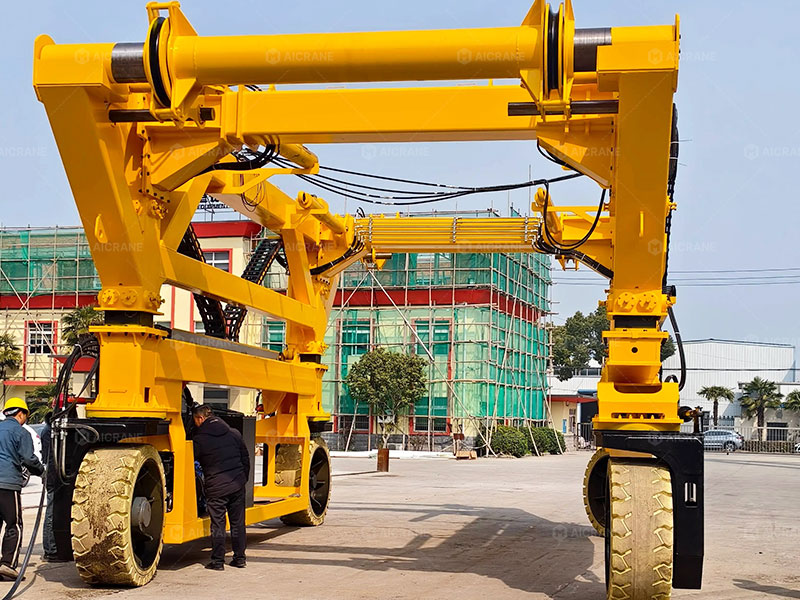
The container spreader connects the carrier to the container. Spreader operation includes positioning, lowering, twist-lock engagement, lifting, and release.
If container alignment is poor or spreader engagement takes longer than expected, the additional seconds are repeated across every handling cycle.
RTG Crane
A rubber tyred gantry crane (RTG crane) uses rubber tires to move between container rows and is commonly used for container stacking and yard handling.
Unlike a straddle carrier, an RTG crane generally operates within a defined stacking block and transfers containers vertically within that area. Therefore, the cycle-time model is different.
In terminals where both equipment types are considered, buyers should compare the complete container-handling workflow, rather than comparing travel speed alone.
RMG Crane
A rail mounted gantry crane (RMG crane) runs on fixed rails and is typically used where container handling follows a more structured rail-mounted yard layout.
Because the equipment is constrained to a rail path, its movement characteristics differ from a rubber-tyred straddle carrier. However, RMG systems can provide high-density and highly repeatable container handling in suitable terminal layouts.
This distinction is important when selecting container handling equipment because the same nominal container-handling task can have very different cycle-time characteristics depending on the equipment and yard configuration.
What Factors Determine Straddle Carrier Cycle Time?
Several factors interact to determine the actual cycle.
1. Travel Distance
Travel distance is one of the most important variables.
If a carrier moves 50 m between a pickup location and a transfer point, its travel time will be substantially different from a 150 m movement.
A simplified calculation is:
Travel time = distance ÷ average operating speed
However, the maximum rated travel speed should not be used directly as the actual cycle-time assumption.
A carrier must accelerate from rest, decelerate before positioning, and may operate at reduced speed around intersections or congested areas.
Therefore, average effective travel speed is more useful for cycle-time planning than maximum rated speed.
2. Acceleration and Deceleration
Maximum travel speed is only one part of carrier performance.
Short-distance container movements can be particularly sensitive to acceleration and braking because the carrier may never have enough distance to reach its maximum speed.
For example, two straddle carriers could have similar maximum travel speeds but produce different cycle times if one reaches operating speed more quickly or performs smoother positioning movements.
3. Container Pickup and Set-Down
Container pickup involves several precise operations:
- Spreader positioning
- Spreader lowering
- Twist-lock engagement
- Container lifting
- Transportation
- Container lowering
- Twist-lock release
The time required depends on the container spreader, lifting system, container condition, operator input, and positioning accuracy.
A standardized container placed correctly within the handling area can generally be picked up more efficiently than one that requires additional alignment.
How Does Stacking Height Affect Cycle Time?
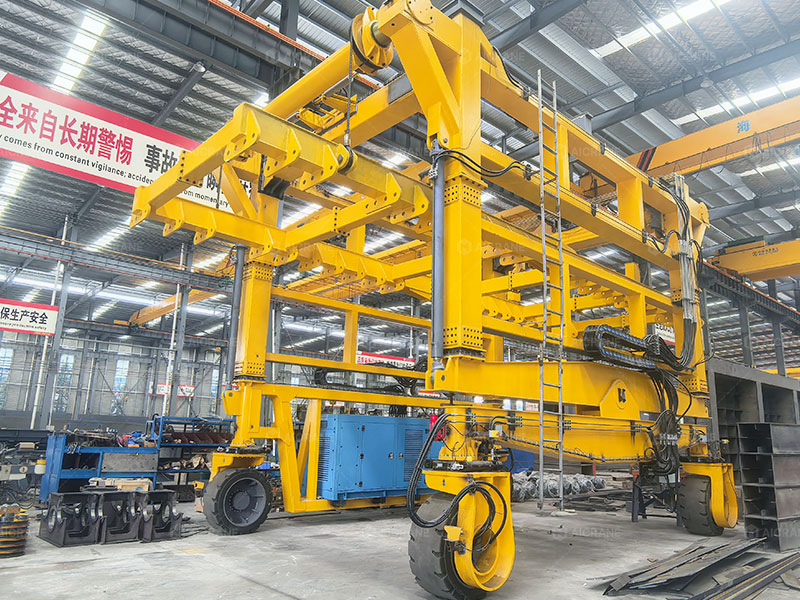
Stacking height affects cycle time because the carrier needs additional hoisting and lowering movement when handling containers at higher tiers.
For example, a ground-level pickup requires less vertical movement than retrieving a container from a higher stacking position.
The effect becomes more important when a terminal performs a large number of stacking and retrieval operations throughout the day.
This creates a practical trade-off:
Higher stacking density can improve yard utilization, but additional vertical handling can increase individual container cycle time.
Therefore, terminal planners should consider both storage density and handling productivity when selecting a straddle carrier or other container-handling system.
How Does Traffic Affect Straddle Carrier Cycle Time?
Traffic can significantly increase actual cycle time.
A theoretical cycle may assume that the carrier can travel continuously between two points. Real operations may involve:
- Other straddle carriers
- Terminal trucks
- Container handling crane
- Intersections
- Blocked lanes
- Transfer-point queues
- Temporary operating restrictions
These conditions create waiting and speed-reduction time.
For this reason, terminal productivity calculations should distinguish between:
Theoretical cycle time — calculated under defined operating assumptions.
Actual cycle time — measured under real operating conditions.
The difference between the two can be substantial in a busy container terminal.
What Is the Difference Between Theoretical and Actual Cycle Time?
Consider a simplified straddle carrier operation:
- Positioning: 40 seconds
- Spreader engagement: 50 seconds
- Hoisting and lowering: 70 seconds
- Effective travel: 180 seconds
- Container release: 20 seconds
The theoretical cycle is:
40 + 50 + 70 + 180 + 20 = 360 seconds
That equals 6 minutes per container cycle.
If the carrier experiences an additional 60 seconds of average waiting or traffic delay, the actual cycle becomes:
360 + 60 = 420 seconds
or approximately 7 minutes.
That additional minute may appear small on an individual move, but it becomes significant when repeated hundreds of times during a shift.
How Does Straddle Carrier Cycle Time Affect Productivity?
A simplified theoretical productivity calculation is:
Cycles per hour = 3,600 ÷ cycle time in seconds
With a 360-second cycle:
3,600 ÷ 360 = 10 cycles/hour
With a 420-second cycle:
3,600 ÷ 420 ≈ 8.6 cycles/hour
This calculation should not be interpreted as guaranteed container moves per hour.
Actual productivity can be affected by:
- Container availability
- Truck arrival patterns
- Traffic
- Equipment downtime
- Operator changes
- Maintenance
- Weather
- Dispatching efficiency
- Empty travel
- Yard congestion
For equipment purchasing, measured operating data or conservative project assumptions are therefore more useful than theoretical cycle time alone.
Which Straddle Carrier Specifications Affect Cycle Time?
When evaluating a straddle carrier, buyers should look beyond rated lifting capacity.
Travel Speed
Higher travel speed can reduce transportation time in large yards with long travel distances.
However, the benefit becomes smaller when the carrier operates mainly over short distances or in congested areas.
Hoisting Speed
Hoisting speed becomes increasingly important when containers are frequently moved between different stacking levels.
Acceleration and Braking
These characteristics affect short-distance movements and repeated stop-and-go operations.
Spreader Performance
The spreader must match the container types and handling requirements.
Efficient engagement and release can reduce repetitive handling delays.
Steering and Maneuverability
A carrier’s steering configuration affects how efficiently it can move around container blocks, transfer points, and intersections.
For yards with complex traffic patterns, maneuverability can have a meaningful impact on actual cycle time.
How Does Yard Layout Affect Straddle Carrier Cycle Time?
Yard layout can be just as important as equipment specifications.
Consider two terminals using the same straddle carrier.
Terminal A has short, direct routes between container stacks and transfer points.
Terminal B requires longer travel distances and frequent crossing movements.
Even if the machines have identical specifications, Terminal A can achieve shorter average cycles because the carrier spends less time traveling and waiting.
Important layout factors include:
- Container block dimensions
- Transfer-point locations
- Truck lanes
- Traffic direction
- Intersections
- Stacking configuration
- Equipment parking areas
- Maintenance access
- Distance between operating zones
This is why container handling equipment selection should be evaluated together with yard-flow design.
How Do Loaded and Empty Travel Affect Cycle Time?
A complete container movement may include:
Empty travel → container pickup → loaded travel → container set-down → empty repositioning
The empty movement is important because it produces no direct container-handling output.
If a dispatching system assigns the carrier to another nearby task after delivery, unnecessary empty travel can be reduced.
If the carrier must travel a long distance without a container before receiving its next assignment, the effective cycle becomes longer.
Therefore, dispatch efficiency and equipment utilization are closely connected to straddle carrier cycle time.
How Does Automation Affect Straddle Carrier Cycle Time?
Automated straddle carrier systems can improve the consistency of container movements by controlling travel routes, positioning, acceleration, and handling sequences according to predefined operating logic.
The main benefit is not necessarily that every individual movement becomes dramatically faster.
Instead, automation can reduce variation caused by inconsistent driving patterns, unnecessary stops, inefficient routing, and poor task allocation.
However, automation does not eliminate physical sources of delay.
Yard layout, container availability, traffic management, equipment reliability, and transfer-point congestion still affect cycle time.
For this reason, automated container handling equipment should be evaluated based on total system productivity rather than one nominal speed specification.
How Can Operators Reduce Straddle Carrier Cycle Time?
The most effective improvements usually come from reducing unnecessary movement and waiting.
Optimize Travel Routes
Shorter and more direct routes reduce travel time.
Reduce Empty Travel
Better task assignment can allow the carrier to move directly from one container task to another.
Improve Container Positioning
Consistent container placement helps the spreader engage faster.
Reduce Traffic Conflicts
Clearly defined traffic routes and operating zones can reduce unnecessary waiting.
Maintain the Handling Equipment
Mechanical problems, tire issues, spreader faults, and hydraulic or electrical problems can create unexpected cycle-time increases.
Monitor Cycle-Time Components
Instead of recording only total cycle time, operators should record:
- Travel time
- Positioning time
- Spreader engagement time
- Hoisting time
- Waiting time
- Empty travel time
This identifies where productivity is actually being lost.
How Should Buyers Compare Straddle Carriers With Other Container Handling Equipment?
The right equipment depends on the terminal’s operating model.
A straddle carrier is useful where flexible movement between container stacks and transfer points is important.
An RTG crane can be more appropriate where container stacking is organized into defined blocks and high stacking density is a priority.
An RMG crane may be appropriate for rail-based container yards where fixed operating paths and structured automation are required.
The comparison should therefore consider:
- Required stacking height
- Container throughput
- Yard dimensions
- Travel distances
- Traffic conditions
- Required flexibility
- Automation level
- Infrastructure requirements
- Maintenance requirements
- Expected operating hours
There is no single cycle-time value that determines which equipment is best. The correct solution depends on the complete terminal workflow.
How Should Straddle Carrier Cycle Time Be Measured?
For an operating terminal, cycle-time analysis should be based on actual container movements.
Useful data includes:
- Pickup location
- Delivery location
- Travel distance
- Container type
- Container weight
- Pickup time
- Spreader engagement time
- Hoisting time
- Loaded travel time
- Set-down time
- Empty travel time
- Waiting time
- Total cycle time
The data should then be analyzed across a sufficiently representative operating period.
Average cycle time shows general productivity, while cycle-time variation can reveal operational instability.
For example, an average cycle of 6 minutes may appear acceptable, but repeated 10- or 12-minute cycles could indicate traffic congestion, poor dispatching, or transfer-point bottlenecks.
What Should Buyers Ask Before Purchasing a Straddle Carrier?
When reviewing supplier productivity data, buyers should ask what assumptions were used.
Important questions include:
- What travel distance is assumed?
- What container type and weight are assumed?
- What stacking height is assumed?
- Is the cycle loaded, unloaded, or a complete round trip?
- Is waiting time included?
- What travel speed is assumed?
- Are acceleration and braking included?
- What spreader configuration is used?
- What yard layout is assumed?
- Is the carrier manually operated or automated?
- Is the productivity figure theoretical or based on field operation?
These questions make equipment comparisons much more meaningful.
A quoted productivity figure should never be evaluated independently from the operating conditions used to calculate it.
Conclusion
Straddle carrier container handling cycle time is determined by the complete container-handling sequence rather than by travel speed alone. Travel distance, acceleration, positioning, spreader operation, hoisting, stacking height, traffic, waiting, empty travel, and yard layout all influence the actual cycle.
For buyers, the most important step is to compare equipment using consistent operating assumptions. For terminal operators, breaking the cycle into individual components can reveal where time is being lost.
The best container-handling solution is therefore not necessarily the machine with the highest rated speed. It is the equipment system that can deliver short, repeatable, safe, and reliable cycles under the terminal’s actual operating conditions.