Building roads in Kalimantan, developing infrastructure in Papua, or constructing bridges across remote Indonesian islands often creates one major challenge: maintaining a reliable concrete supply. Ready-mix suppliers may operate far from the construction site. Long transportation distances, poor road conditions, ferry schedules, and limited local suppliers can increase concrete delivery costs and disrupt construction schedules.
For contractors working in these locations, a 60 m³/h portable concrete batching plant can offer a practical alternative. It provides on-site concrete production while allowing the equipment to move between project locations when necessary. However, before making an investment, most contractors want to know one thing: How much does a 60 m³/h portable concrete batching plant cost in Indonesia, and what additional expenses should they prepare for?
The compact concrete batching plant price depends on the plant configuration, mixer type, automation level, aggregate storage, cement silo capacity, and transportation requirements. More importantly, a remote construction project requires a different cost calculation from a plant installation near Jakarta or Surabaya. This guide explains the main price factors and helps contractors estimate the total investment before requesting a quotation.
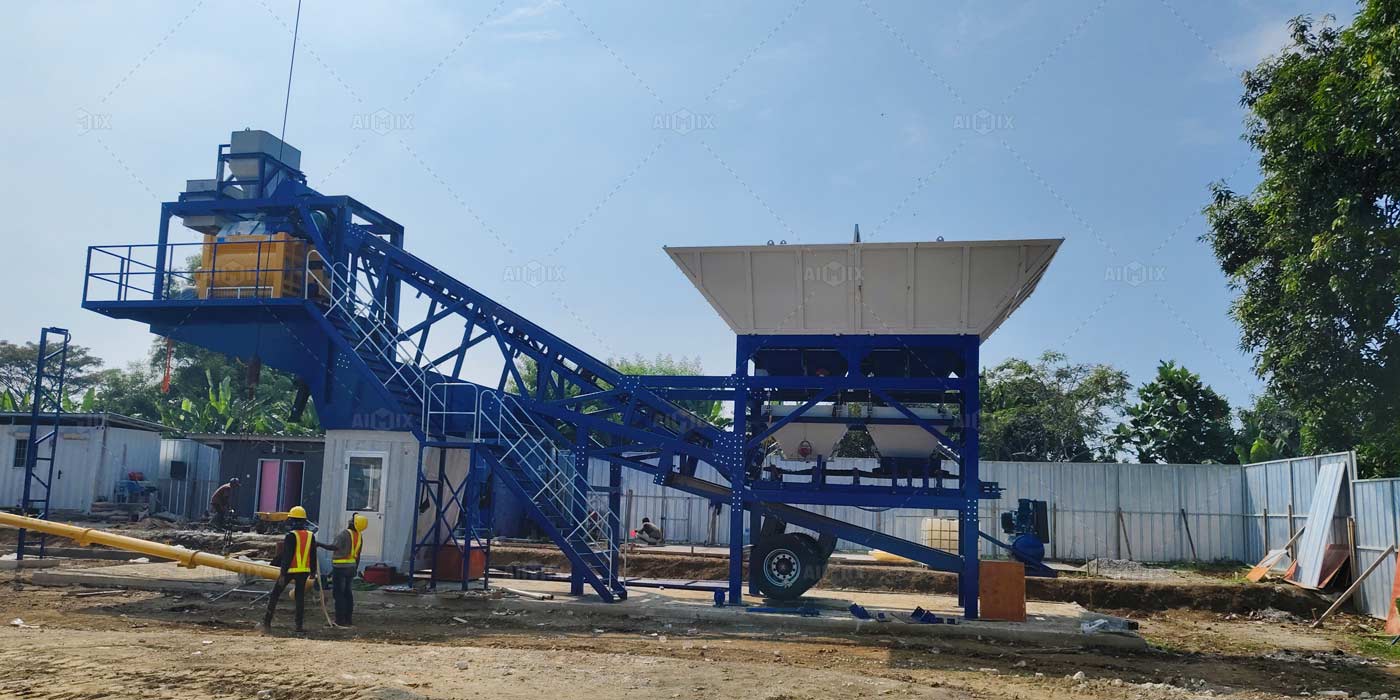
How Much Does a 60 m³/h Portable Batching Plant Cost in Indonesia?
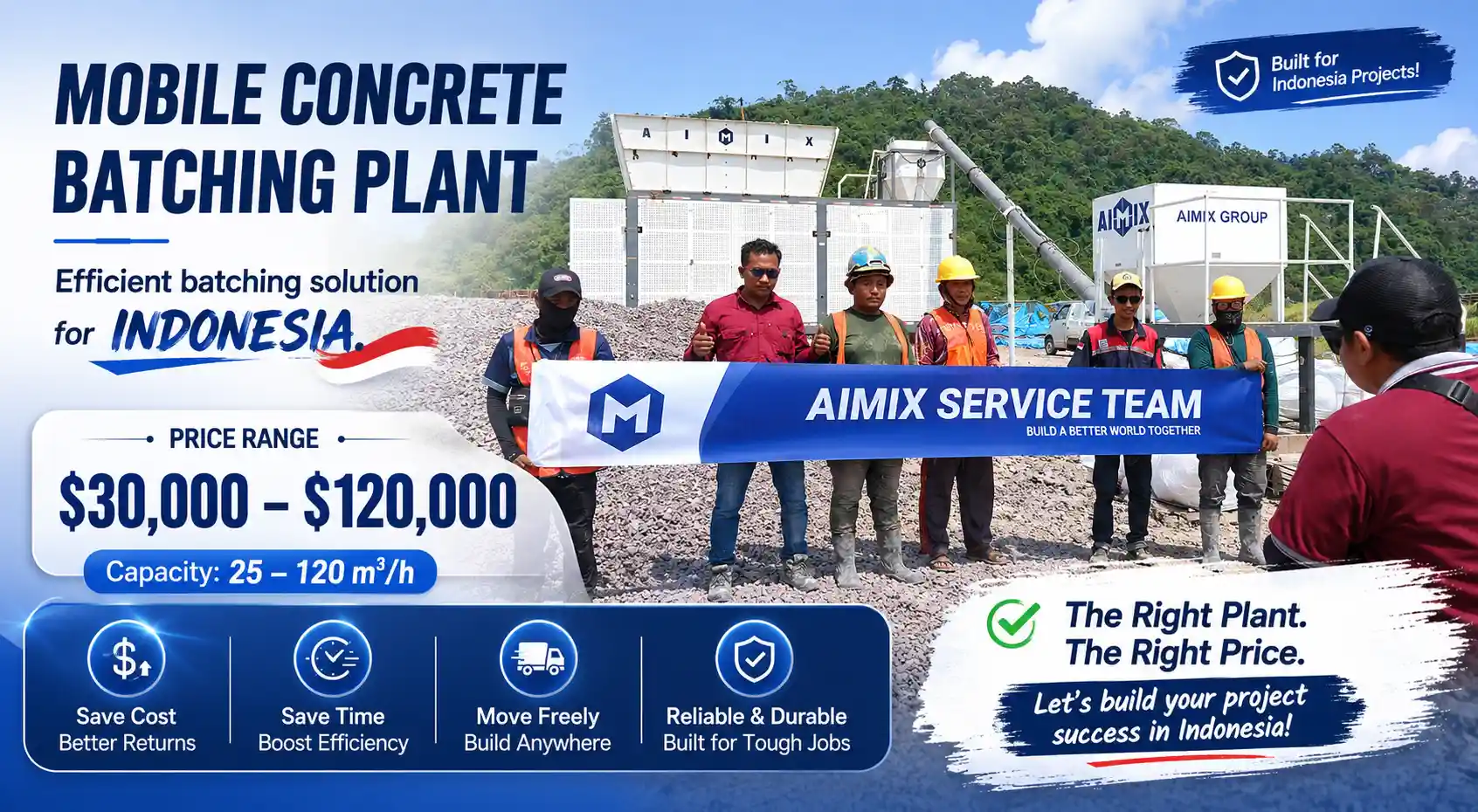
For an initial budget, portable and mobile concrete batching plants in Indonesia can fall within an approximate equipment price range of USD 30,000–120,000, depending on capacity and configuration. A 60 m³/h model should be quoted according to its actual equipment package rather than assuming that every plant within this range has the same specifications.
For a remote construction project, the purchase price is only the starting point. Shipping, inter-island transportation, unloading, site preparation, installation, electrical connections, and auxiliary equipment can increase the total investment.
Buyers researching the concrete batching plant price should compare the complete equipment configuration rather than focusing only on the advertised starting price. A quotation with fewer components may look cheaper initially but require additional purchases before production can begin.
Typical Price Components
| Cost Component | What It Includes |
|---|---|
| Main equipment | Mixing system, aggregate batching, weighing systems, control system, and supporting structures. |
| Cement storage | Cement silo, screw conveyor, dust collector, and related accessories. |
| Transportation | Factory-to-port shipping, domestic freight, inter-island transportation, and site delivery. |
| Installation | Mechanical assembly, electrical connections, commissioning, and technical supervision. |
| Site preparation | Ground leveling, drainage, access roads, and required foundations or support structures. |
| Auxiliary equipment | Wheel loader, generator, water supply, and other site facilities where required. |
Therefore, contractors should request an itemized quotation that clearly separates the equipment price from transportation, installation, and optional accessories. This makes it easier to compare suppliers and avoid unexpected expenses after the equipment arrives.
Why Is a 60 m³/h Portable Batching Plant Suitable for Remote Indonesian Projects?
Before comparing prices, it is worth understanding why this capacity attracts infrastructure contractors. A 60 m³/h plant offers a balance between production capacity and equipment mobility. It can support medium-sized construction projects without requiring the same production scale as a large stationary concrete plant.
1. Produce Concrete Near the Construction Site
Remote projects often depend on concrete transported from commercial batching plants located tens or even hundreds of kilometers away. This arrangement can create additional costs and operational risks.
For example, road construction in Central Kalimantan may involve long transportation routes through areas with limited road infrastructure. Similarly, contractors working in Papua or Maluku may face additional shipping and delivery challenges.
With a portable batching plant, contractors can establish concrete production closer to the work area. This reduces dependence on long-distance ready-mix delivery and gives the project team more control over production schedules.
2. Support Multiple Construction Activities
A 60 m³/h plant can supply concrete for different infrastructure applications, including:
- Rural roads and highway construction.
- Bridge foundations, piers, and structural components.
- Port facilities and coastal infrastructure.
- Industrial buildings and warehouses.
- Residential developments and commercial construction.
- Drainage channels and water infrastructure.
- Precast concrete products and components.
Because these activities have different concrete requirements, contractors should also consider the required mix quality, aggregate sizes, and daily production schedule when selecting the plant.
3. Relocate Between Project Sites
Some Indonesian contractors manage several construction contracts across different districts or islands. Keeping a stationary batching plant at every project location can increase capital requirements.
A portable configuration offers greater flexibility. Depending on its structural design, transportation arrangement, and dismantling requirements, the plant can move to another site after completing its current assignment.
However, buyers should distinguish between a mobile design and a fully transport-ready configuration. Some plants require partial dismantling, separate transportation of silos, or additional lifting equipment before relocation.
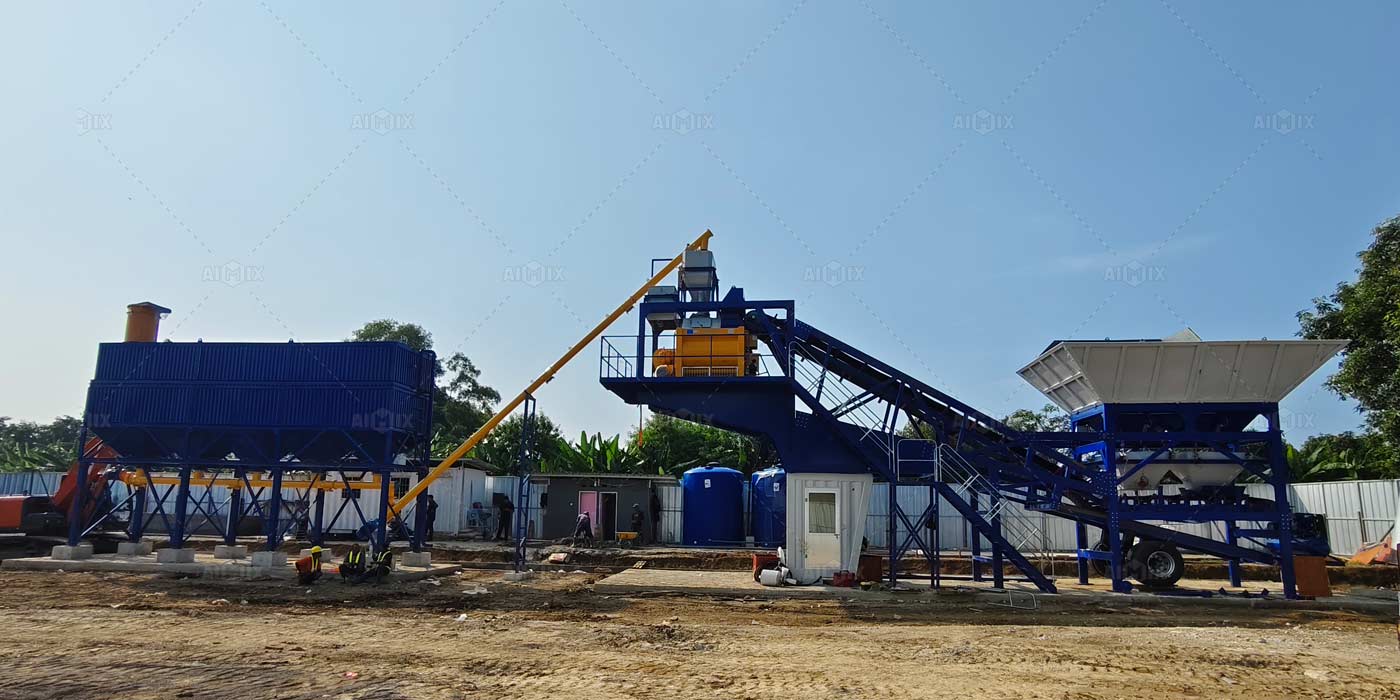
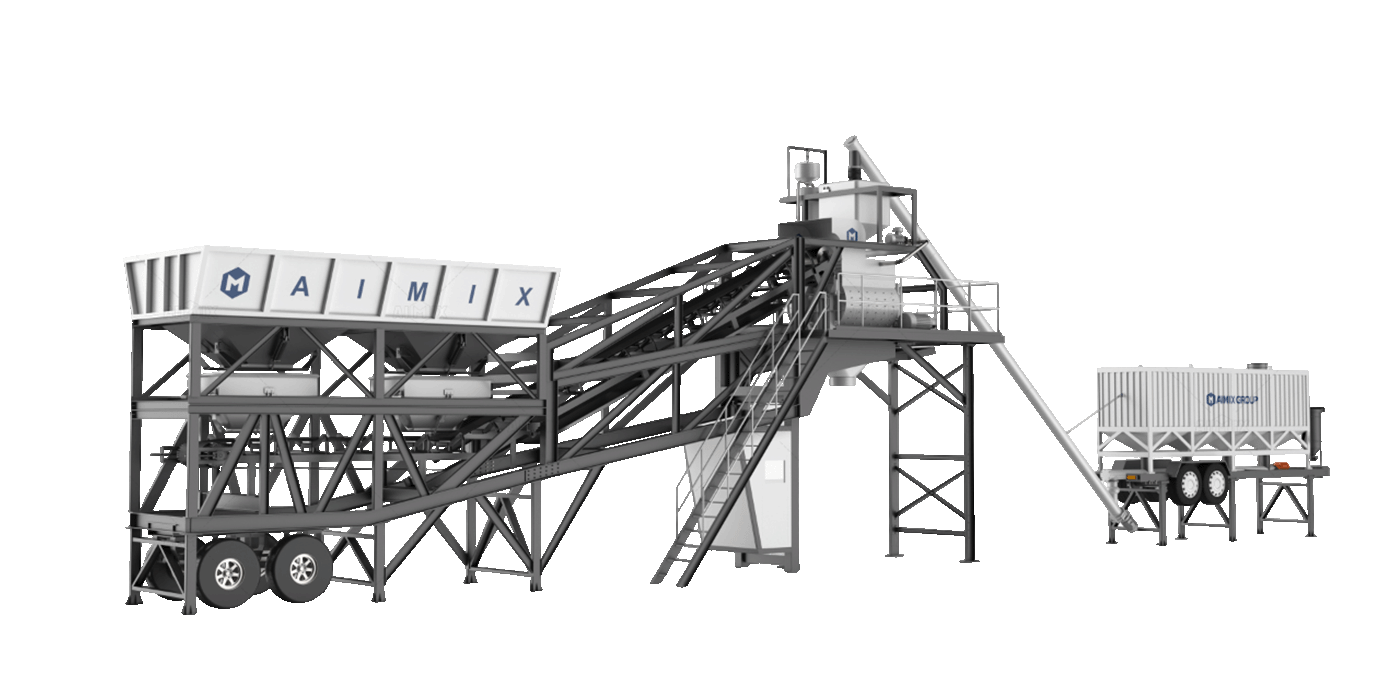
What Configuration Does a 60 m³/h Portable Concrete Batching Plant Need?
Not every 60 m³/h plant has the same price because different projects require different equipment configurations. A contractor building a rural road may prioritize mobility and simple operation. Meanwhile, a bridge contractor may focus more on mixing consistency, weighing accuracy, and continuous concrete supply.
Consequently, understanding the main components helps buyers decide which configuration offers the best value.
Concrete Mixer System
The mixer is one of the most important components because it directly affects concrete mixing quality and production efficiency.
For a 60 m³/h wet concrete batching plant, a twin-shaft mixer is a common configuration. It provides intensive mixing and supports different concrete mix designs used in structural construction.
However, contractors should confirm the actual mixer model, feeding volume, discharge volume, and mixing cycle. A theoretical capacity of 60 m³/h does not mean the plant will continuously deliver 60 m³ of finished concrete under every site condition.
Aggregate Batching and Storage System
Aggregates represent a large proportion of concrete production costs. Therefore, the batching system needs to measure different aggregate sizes accurately.
A typical configuration may include multiple aggregate bins, weighing equipment, and a feeding conveyor. The required number and capacity of bins depend on the concrete mix designs and the availability of local materials.
For remote projects, contractors should also consider whether local aggregate suppliers can provide consistent material sizes and quality. Poor aggregate management can interrupt production even when the batching plant has sufficient rated capacity.
Cement Silo and Screw Conveyor
Remote locations may not have convenient access to cement suppliers. As a result, sufficient cement storage becomes important for maintaining production continuity.
A 100-ton cement silo is one possible configuration, although the appropriate storage capacity depends on daily concrete consumption, delivery frequency, and available storage space.
Contractors should also consider screw conveyor capacity, dust collection, silo loading arrangements, and the accessibility of cement delivery vehicles.
Automatic Control and Weighing System
A reliable control system helps operators manage aggregate, cement, water, and additive proportions. It also allows the production team to maintain consistent mix designs across different batches.
For projects with limited access to experienced batching plant operators, an automatic PLC control system can simplify daily operation. However, buyers should check whether the supplier provides operator training, troubleshooting support, and remote technical assistance.
What Additional Costs Should Remote Projects in Indonesia Consider?
This is where remote construction projects differ significantly from ordinary urban installations. A plant delivered to a project near Jakarta may have relatively straightforward logistics. However, sending the same equipment to a remote location in Papua, North Maluku, or East Nusa Tenggara can involve several transportation stages.
Therefore, contractors should calculate the full delivery and installation process before approving the equipment purchase.
1. Inter-Island Transportation and Port Handling
Indonesia’s geographical conditions make transportation an important part of equipment investment. Depending on the destination, the plant may travel by truck, container vessel, cargo ship, or a combination of different transport methods.
For projects in Kalimantan, Sulawesi, Papua, or Maluku, buyers should confirm the nearest suitable port and the available route to the construction site.
Transportation costs can depend on:
- Equipment dimensions and total shipping weight.
- Containerized or oversized cargo requirements.
- Distance between the loading and destination ports.
- Port handling and unloading arrangements.
- Road conditions between the destination port and project site.
- Crane, trailer, or heavy-haul transportation requirements.
For this reason, a quotation for a portable batching plant should specify the delivery destination. A general equipment price without a confirmed destination cannot accurately represent the total project investment.
2. Site Preparation and Installation
Portable does not always mean completely foundation-free. Some mobile batching plants require simple support foundations, while other compact designs can operate with minimal civil preparation.
Before selecting a configuration, contractors should check the soil conditions, ground level, drainage, equipment access, and available installation space.
Remote locations may also have limited access to cranes, welding equipment, electricians, and experienced installation workers. Arranging these resources in advance can prevent unnecessary installation delays.
3. Electricity and Generator Requirements
Not every remote construction site has a stable grid electricity connection. Road construction, mining infrastructure, and bridge projects may operate in locations where contractors need an independent power supply.
In these situations, a diesel generator may be necessary. However, its capacity must match the plant’s installed electrical power and starting requirements.
Buyers should confirm the plant’s voltage, frequency, phase, total installed power, and compatibility with the available site power supply before ordering.
4. Raw Material Supply and Storage
Even a well-configured batching plant cannot maintain production without reliable raw material supplies.
Remote projects should prepare a material supply plan covering cement, sand, aggregates, water, and chemical admixtures. Contractors should estimate daily consumption and determine how frequently each material needs replenishment.
For example, a project producing 300 m³ of concrete per day may require substantial aggregate and cement storage. Without sufficient stock, the plant may stop production while waiting for material deliveries.
Portable vs. Stationary Batching Plant: Which Offers Better Value?
Although a portable plant offers mobility, it is not automatically the best investment for every 60 m³/h project. Contractors should compare the total ownership cost and expected operating period of different plant configurations.
For projects that need frequent relocation, checking the mobile batching plant price can help buyers understand how mobility features and transport arrangements affect the investment. However, the actual comparison should use equivalent production capacities and equipment configurations.
| Comparison | Portable Batching Plant | Stationary Batching Plant |
|---|---|---|
| Equipment mobility | Designed for easier transportation and relocation | Generally remains at one site |
| Installation | Usually faster, depending on configuration | Often requires more extensive site preparation |
| Site requirements | Can suit temporary and changing locations | Better suited to permanent production sites |
| Relocation costs | Potentially lower, depending on transport design | May require more dismantling and reassembly |
| Long-term application | Multiple projects and temporary sites | Long-term production at one location |
For contractors managing several temporary infrastructure projects, portability can provide considerable operational value. On the other hand, a contractor operating a permanent ready-mix concrete business may achieve better long-term efficiency with a stationary configuration.
The best decision depends on project duration, production demand, relocation frequency, and the available installation area.
How Much Concrete Can a 60 m³/h Portable Plant Produce Per Day?
Capacity is another important factor when calculating whether a 60 m³/h plant can meet a remote project’s concrete demand.
Its rated production capacity is 60 m³ per hour. However, actual output depends on the mixing cycle, aggregate supply, material loading, equipment availability, operator performance, and concrete transportation arrangements.
Daily Production Example
For preliminary planning, assume the plant achieves 70% of its rated output during an eight-hour production shift.
60 m³/h × 70% × 8 hours = 336 m³ per day.
This represents an illustrative production estimate rather than a guaranteed output. Actual daily production may be lower or higher depending on site conditions and operational efficiency.
| Operating Hours | Rated Daily Output | Output at 70% Utilization |
|---|---|---|
| 6 hours | 360 m³ | 252 m³ |
| 8 hours | 480 m³ | 336 m³ |
| 10 hours | 600 m³ | 420 m³ |
These figures help contractors estimate the required production schedule. However, the plant must also match the concrete pump, mixer trucks, aggregate feeding system, and placement capacity. Producing concrete faster than the site can transport or place it does not necessarily improve project productivity.
Which Indonesian Regions Benefit Most From a Portable 60 m³/h Plant?
Indonesia’s infrastructure development creates demand for flexible concrete production across different regions. However, the economic advantages of a portable plant can vary according to local supply conditions and project accessibility.
Kalimantan: Road Construction and Industrial Infrastructure
Road development, industrial facilities, mining-related infrastructure, and supporting construction projects can involve long distances between material suppliers and work sites.
A portable batching plant can help contractors establish concrete production near the construction area. It can also support different construction sections as the project progresses.
Papua: Remote Infrastructure and Bridge Projects
Some construction sites in Papua have challenging road access and limited local concrete supply. Delivering ready-mix concrete over long distances may create significant logistical pressure.
On-site batching can provide greater control over concrete production for bridge foundations, access roads, drainage, and other infrastructure works. However, contractors should pay particular attention to equipment transportation, spare parts availability, and technical support.
Sulawesi: Roads, Ports, and Industrial Projects
Construction activities across Sulawesi can involve coastal infrastructure, industrial development, road improvements, and commercial buildings.
For contractors handling multiple project locations, a portable plant can reduce the need to establish a completely new concrete production facility at every site.
Maluku and Nusa Tenggara: Island-Based Construction
Island construction projects often involve additional marine transportation and limited local equipment resources. A portable plant can support concrete production closer to the work area, especially when ready-mix suppliers are unavailable or unreliable.
Nevertheless, buyers should compare the cost of shipping the equipment with the expected concrete demand and project duration. Mobility provides value only when the total logistics arrangement remains practical.
How to Reduce the Total Investment in a Remote Batching Plant Project
Buying a portable batching plant does not mean choosing the cheapest available configuration. Instead, contractors should identify unnecessary expenses while protecting the equipment features that directly affect production.
Choose the Right Silo Capacity
A larger cement silo increases storage capacity but also affects transportation, installation, and site requirements. Calculate daily cement consumption and delivery frequency before choosing the silo size.
Use Existing Site Resources
If the project already has a wheel loader, generator, water storage system, or suitable access roads, the contractor may not need to purchase every auxiliary facility separately.
Confirm equipment compatibility and actual operating conditions before excluding any components from the quotation.
Plan Transportation Before Ordering
Check the shipping route, port access, cargo dimensions, unloading equipment, and final site accessibility. This is particularly important for projects involving several islands or locations far from major ports.
Early logistics planning can reduce unexpected handling charges and help the equipment arrive according to the construction schedule.
Prioritize Spare Parts and Technical Support
A low initial purchase price may become expensive if the plant stops operating because of a missing spare part or delayed technical assistance.
For remote projects, confirm the availability of wearing parts, electrical components, weighing sensors, maintenance guidance, and remote troubleshooting support. A reliable after-sales arrangement helps protect production continuity.
What Information Is Needed to Get an Accurate 60 m³/h Plant Quotation?
Because remote project conditions differ significantly, suppliers need more than the requested production capacity to prepare an accurate quotation.
Before requesting a price, contractors should prepare the following information:
- Project location: Province, city, island, and nearest delivery port.
- Project application: Road, bridge, port, industrial construction, housing, or other infrastructure.
- Required capacity: Whether 60 m³/h is the required rated output or the expected actual production.
- Plant configuration: Twin-shaft mixer, drum mixer, aggregate bins, and cement silo requirements.
- Mobility requirements: How often the plant needs to move between project sites.
- Operating schedule: Daily working hours and estimated total concrete demand.
- Site conditions: Available space, road access, electricity, water, and foundation requirements.
- Delivery schedule: Expected equipment arrival and project commencement dates.
With this information, the supplier can recommend a suitable configuration and calculate equipment, transportation, and installation costs more accurately.
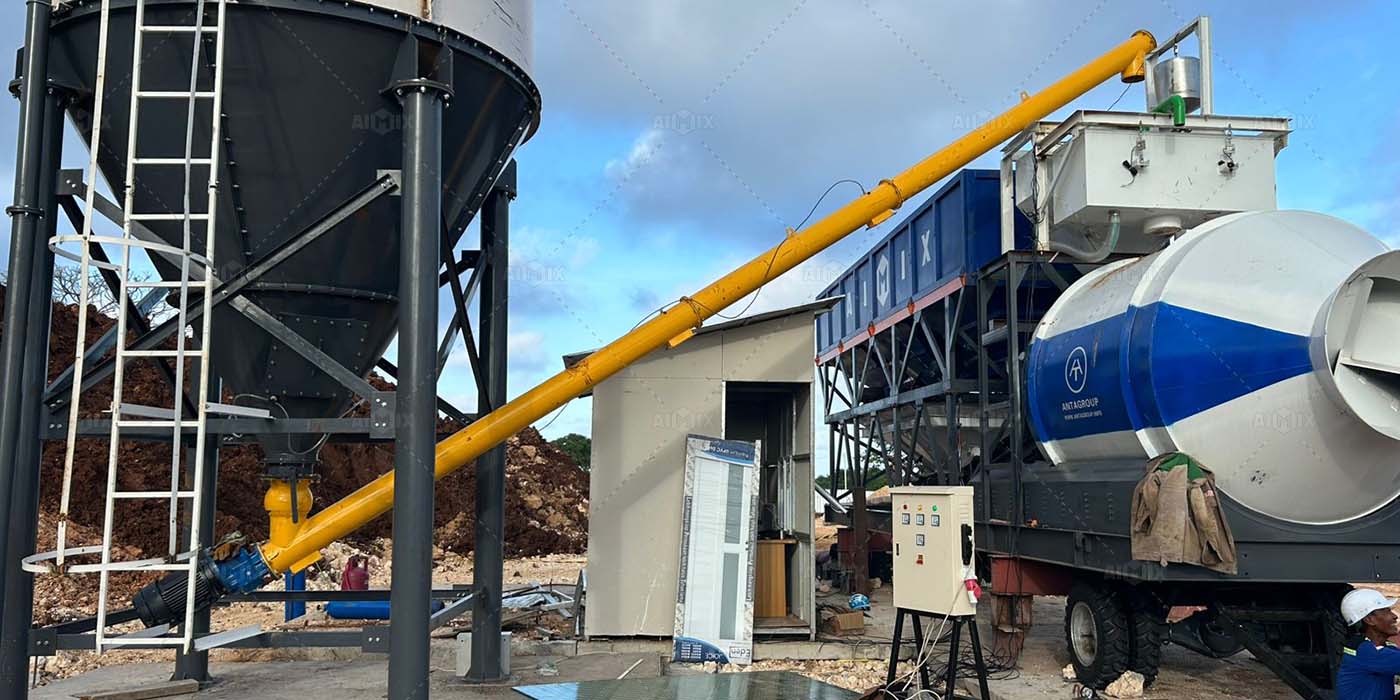
Why Choose AIMIX for a Portable Concrete Batching Plant in Indonesia?
For remote construction projects, selecting a batching plant manufacturer involves more than comparing equipment specifications. Contractors also need a supplier that understands transportation challenges, installation requirements, and the importance of after-sales support.
AIMIX provides concrete batching solutions for different construction capacities and operating conditions. Our compact concrete batching plant price options can also help contractors compare smaller-footprint configurations when site space and transportation restrictions influence equipment selection.
Through PT AIMIX GROUP INDONESIA, we provide local sales communication and project support for Indonesian customers. Our team can help evaluate equipment configurations, delivery arrangements, installation requirements, and spare parts planning according to the project location.
Whether your project is in Kalimantan, Papua, Sulawesi, Sumatra, or another Indonesian region, the equipment recommendation should reflect actual site conditions rather than capacity alone.
When comparing suppliers, contractors should also evaluate the complete concrete batch plant equipment package, including the mixer, aggregate batching system, cement storage, weighing equipment, control system, and auxiliary components. This helps ensure that the quoted plant can operate as a complete production system.
Get a Customized Price for Your 60 m³/h Portable Batching Plant
A 60 m³/h portable concrete batching plant can be a practical investment for remote construction projects in Indonesia. It helps contractors establish on-site concrete production, reduce dependence on distant ready-mix suppliers, and manage construction schedules more flexibly.
However, the right investment is not determined by the equipment price alone. Buyers should consider transportation, installation, cement storage, power supply, raw material availability, and future relocation requirements. A well-planned configuration can help control the total project cost while maintaining reliable concrete production.
Are you planning to purchase a 60 m³/h portable concrete batching plant for a remote project in Indonesia? Contact AIMIX for a customized quotation. Tell us your project location, application, required configuration, daily concrete demand, and expected delivery date. Our team will help you evaluate the suitable plant configuration and calculate the equipment and logistics requirements for your project.